Category Archives: Tobacco Pipe Refurbishing

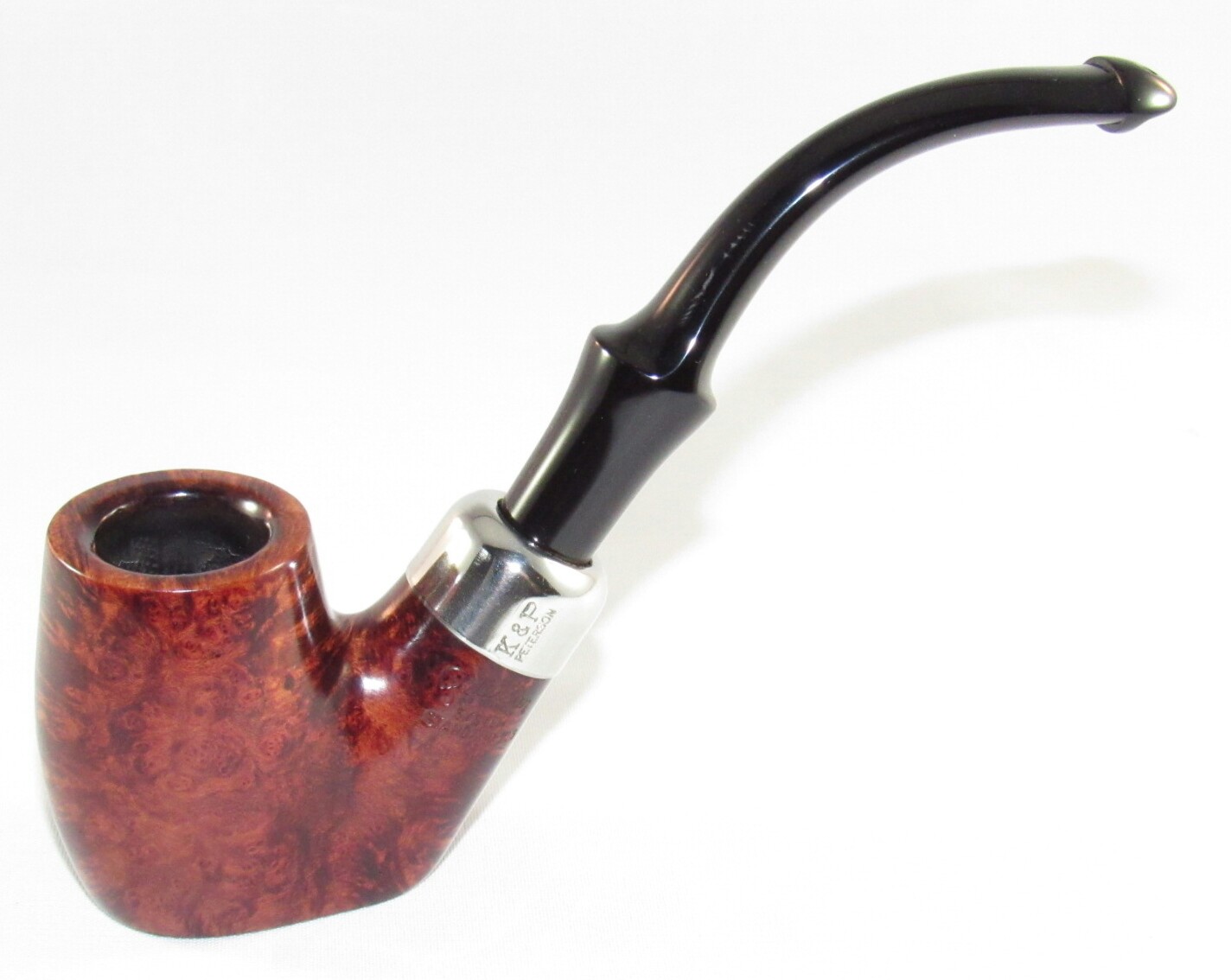
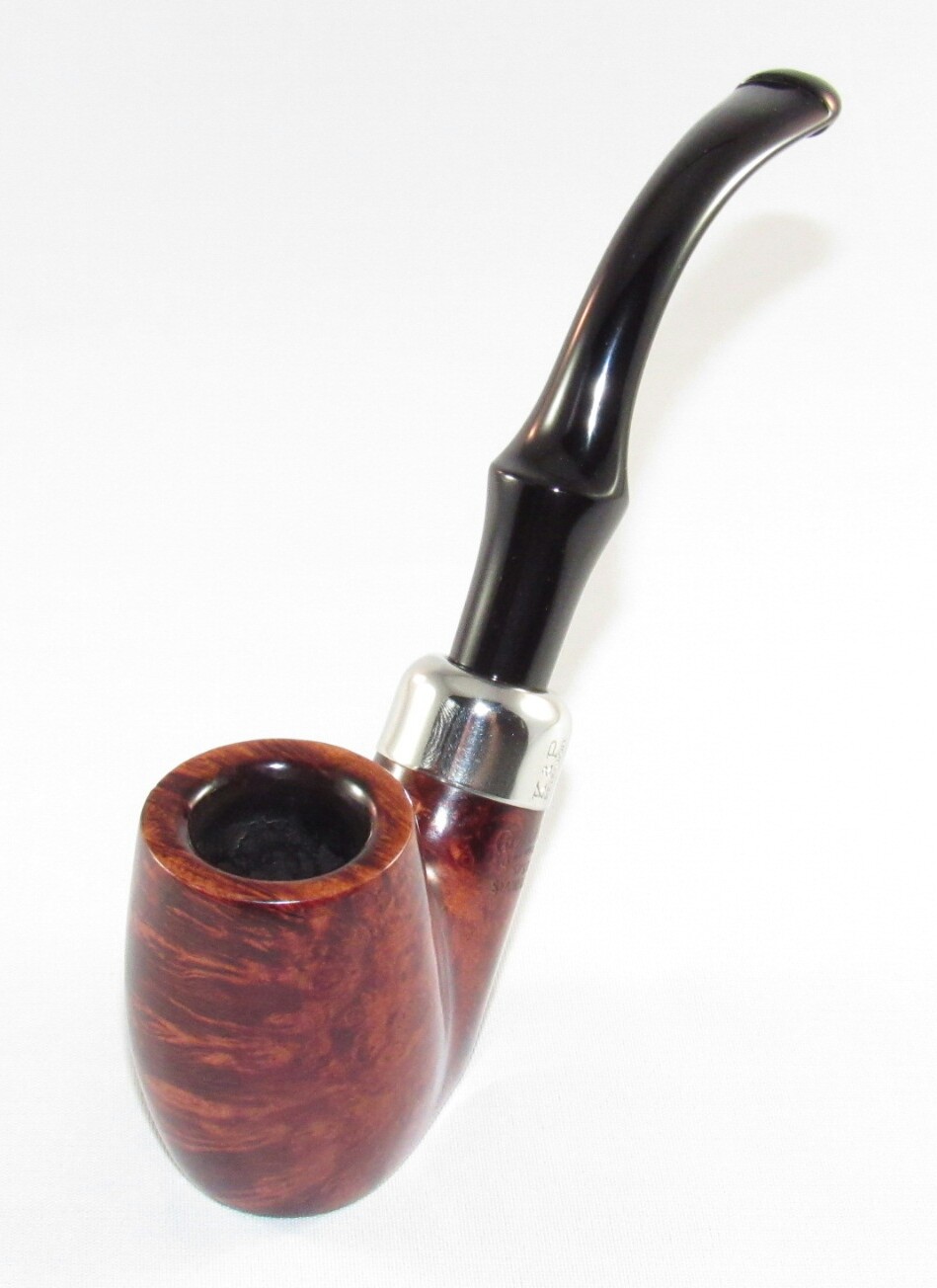
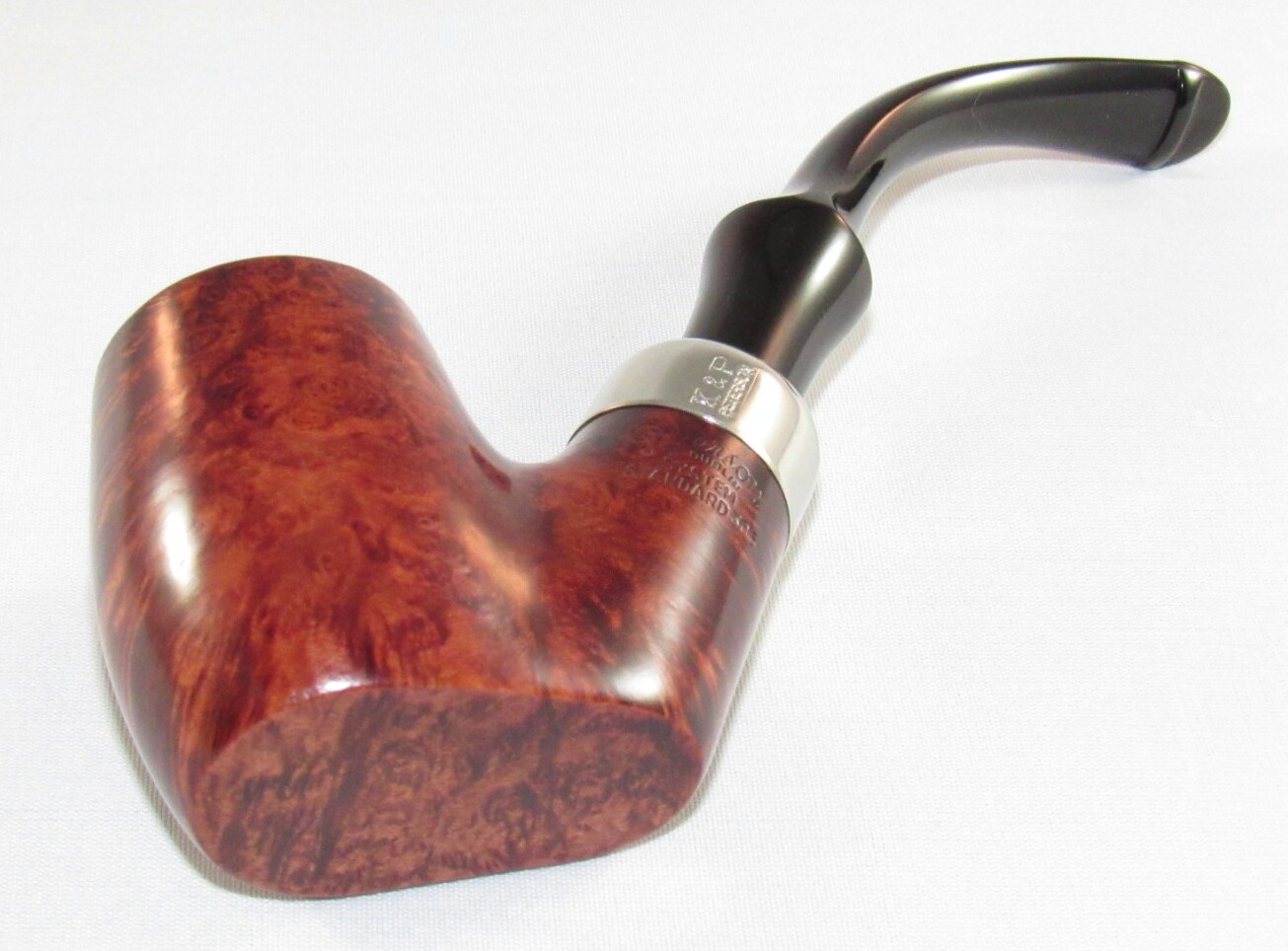
Peterson System Standard 306

Screenshot_2016-01-21-21-34-52~2

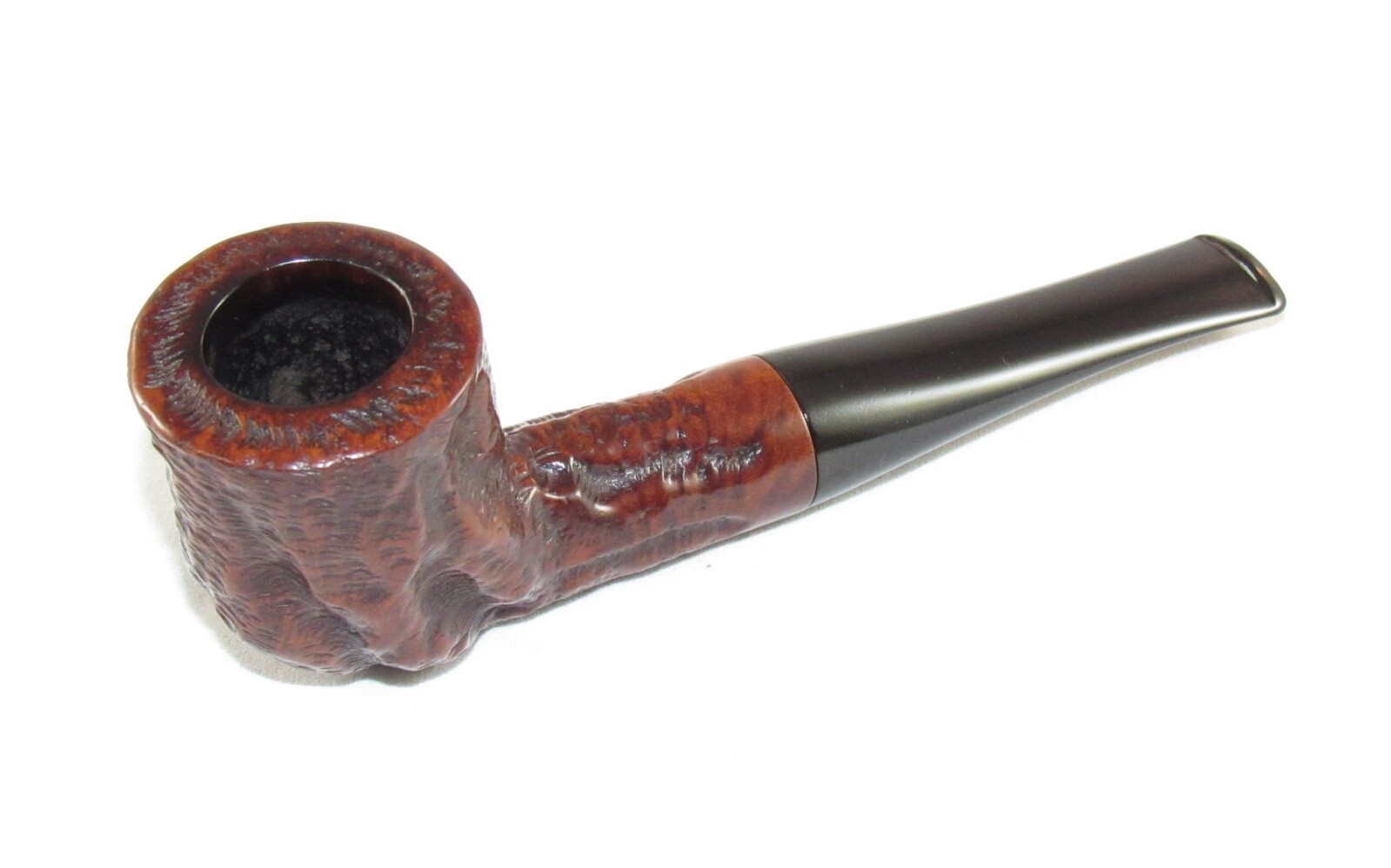
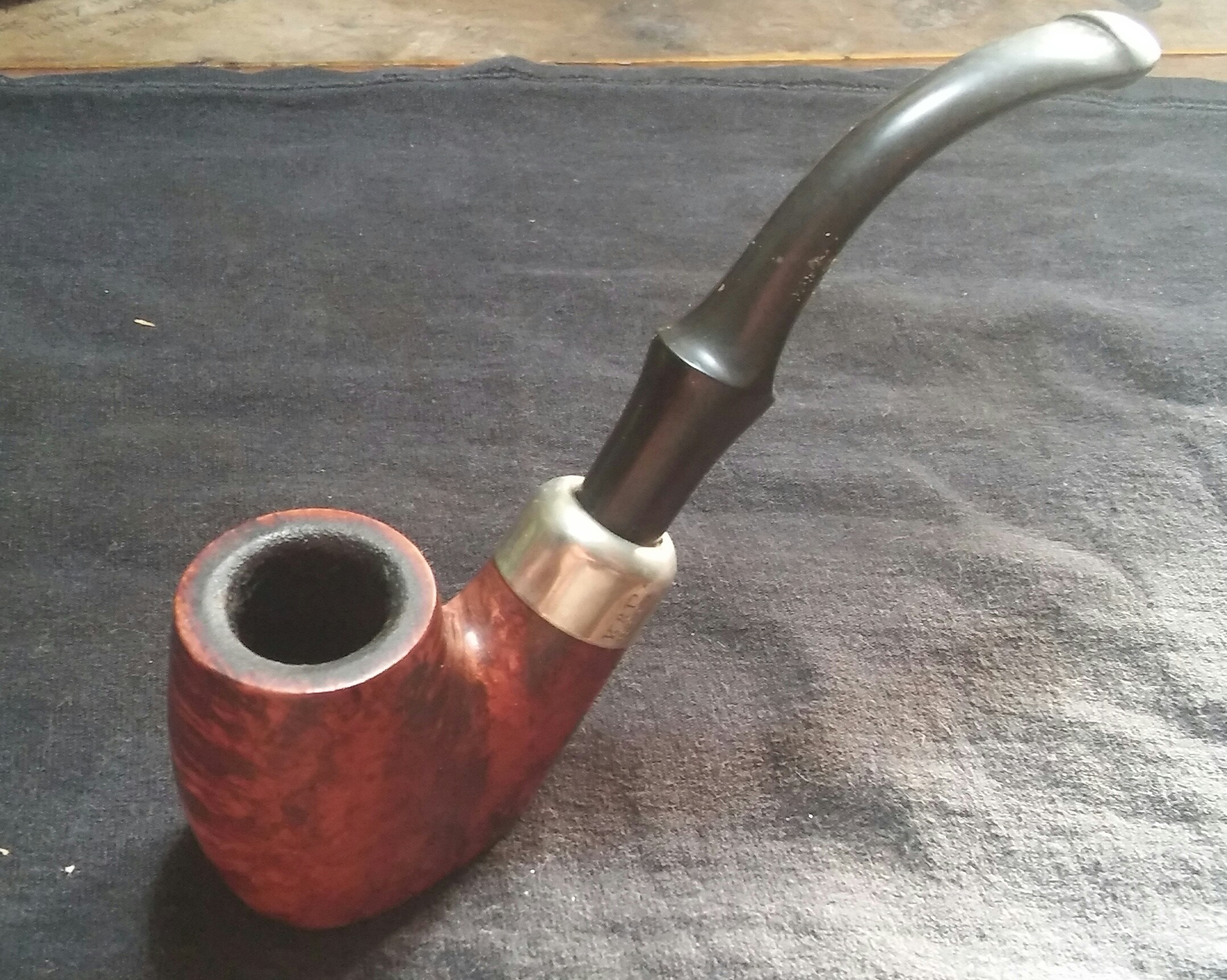
 This is the first of eleven pipes I recently acquired. The Peterson System Standard 306 is the first sitter in my small Peterson collection. I am unsure of its age as it does not have a made in or hallmarks, which I found odd as all my other Petes have some sort of way to date them. The only markings on the pipe is Peterson of Dublin System Standard 306 and K&P Peterson on the band.
As Received.

 

20160223_081032~220160223_080952~220160223_080944~220160223_081050~2PhotoGrid_1456276037968

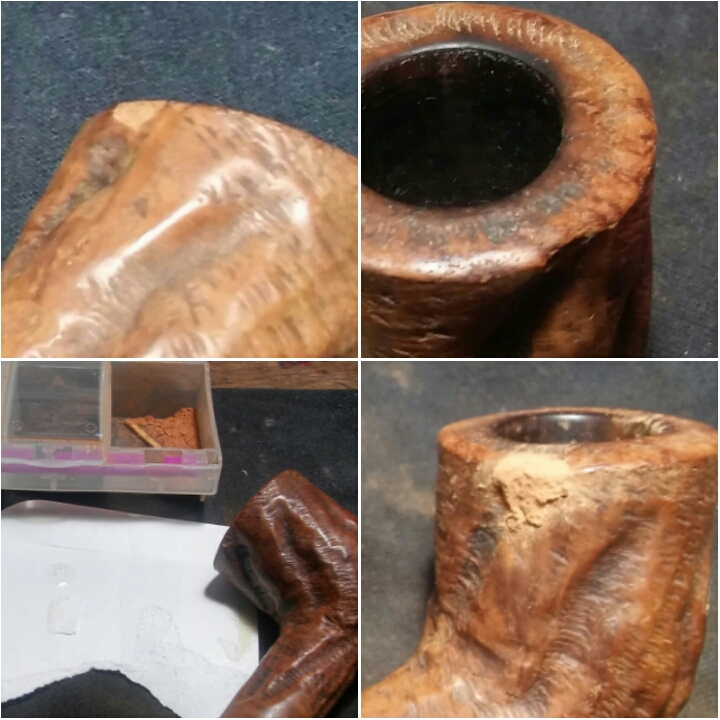
Over all in pretty descent shape, the stem was oxidized and a few tooth impressions. The chamber had an uneven crumbling cake and the rim was built up with old tar/oils, there is also charring around the inside edge of the rim. The finnish was worn and tired and one small spot of filler. The biggest hurdle was the Lakeland ghost.
20160223_081648~220160223_081920~2

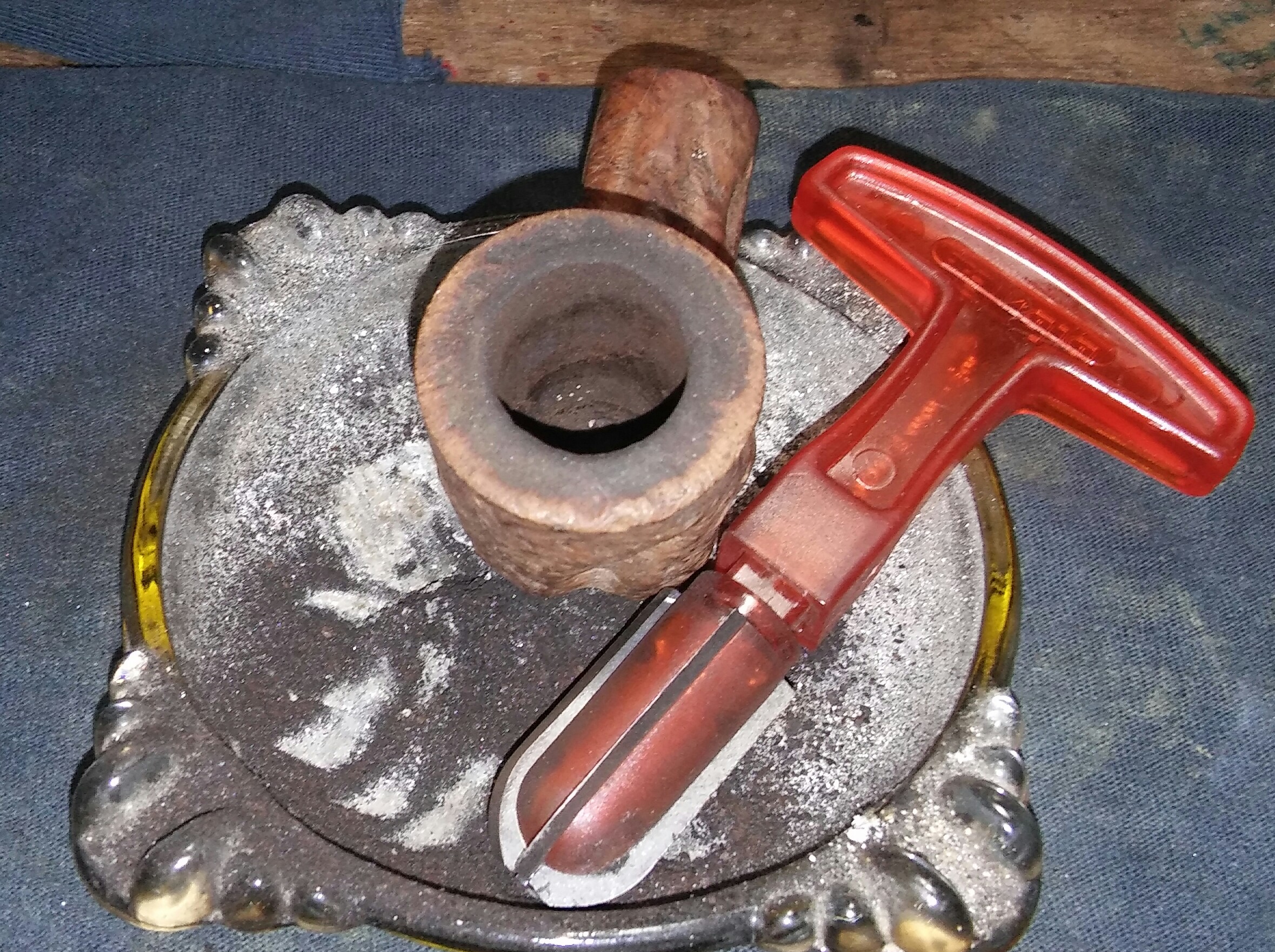
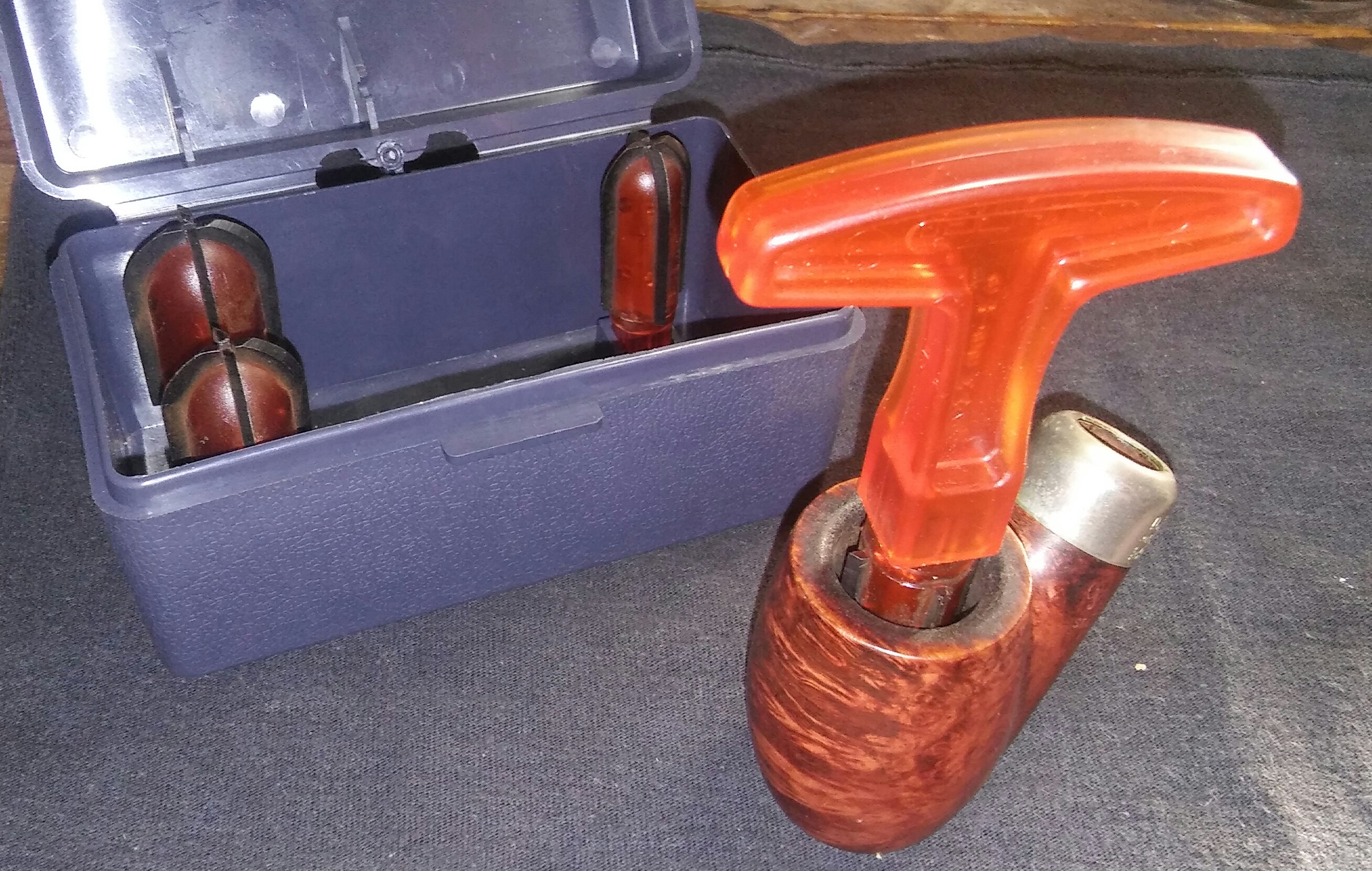
I started with the stummel and my Pipnet Reamer. Starting with the smallest attachment and working up to the second largest, I brought the chamber back to briar, it was free of burn or pitting. I smoothed things out with 400 grit sandpaper wrapped around a finger .

PhotoGrid_1456276847786

Next I could tackle the caked and charred rim. I applied a generous amount of Method Good For Wood Polish to the rim and set it aside to penetrate the build-up for a few minutes. Using Q-tips I removed the rim build-up, I would repeat this process a few times to remove all the debris. After the build-up was removed the rim darkening was still present, using worn micro-mesh I was able to fade most of the darker spots of the rim.

PhotoGrid_1456276703846

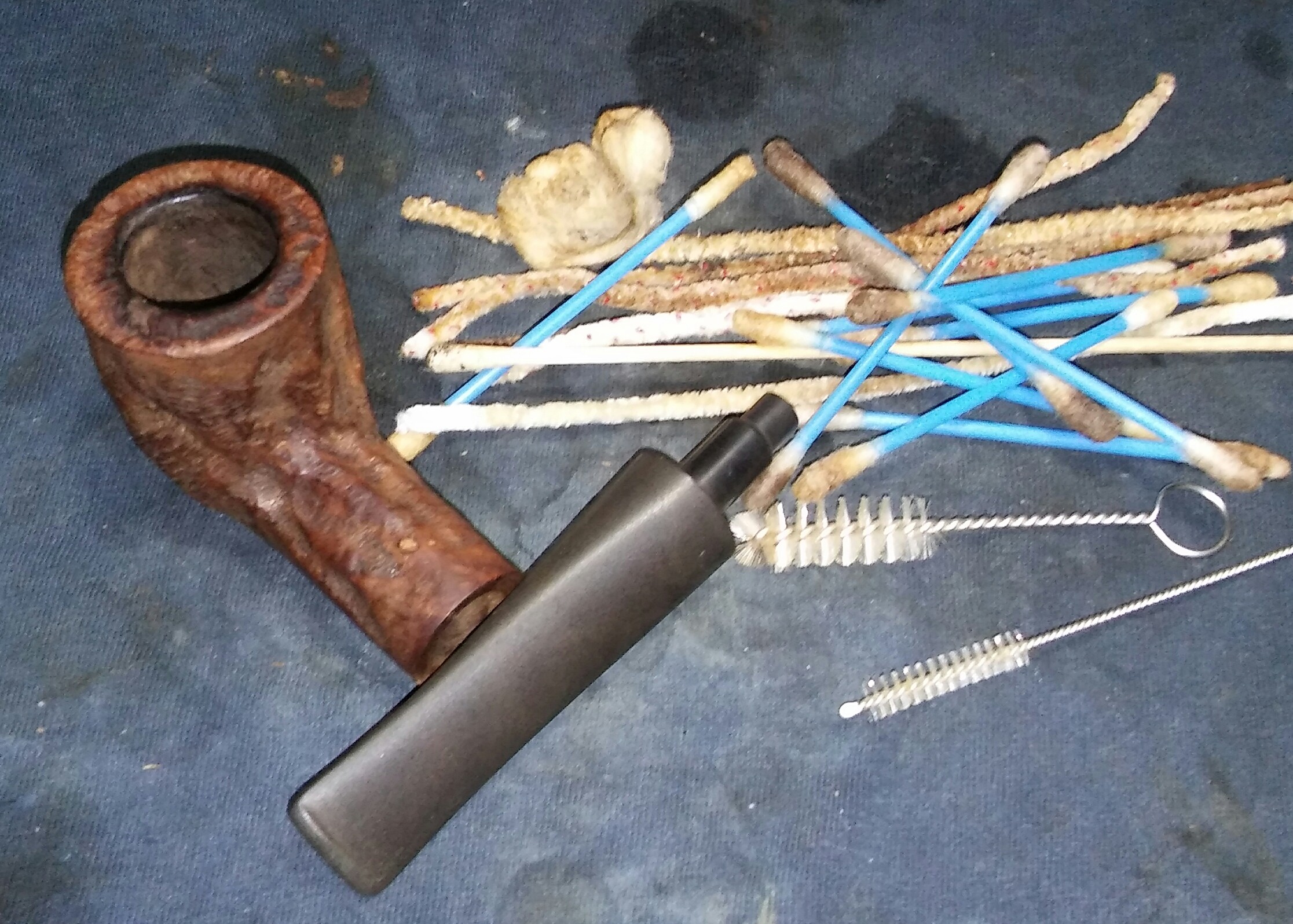
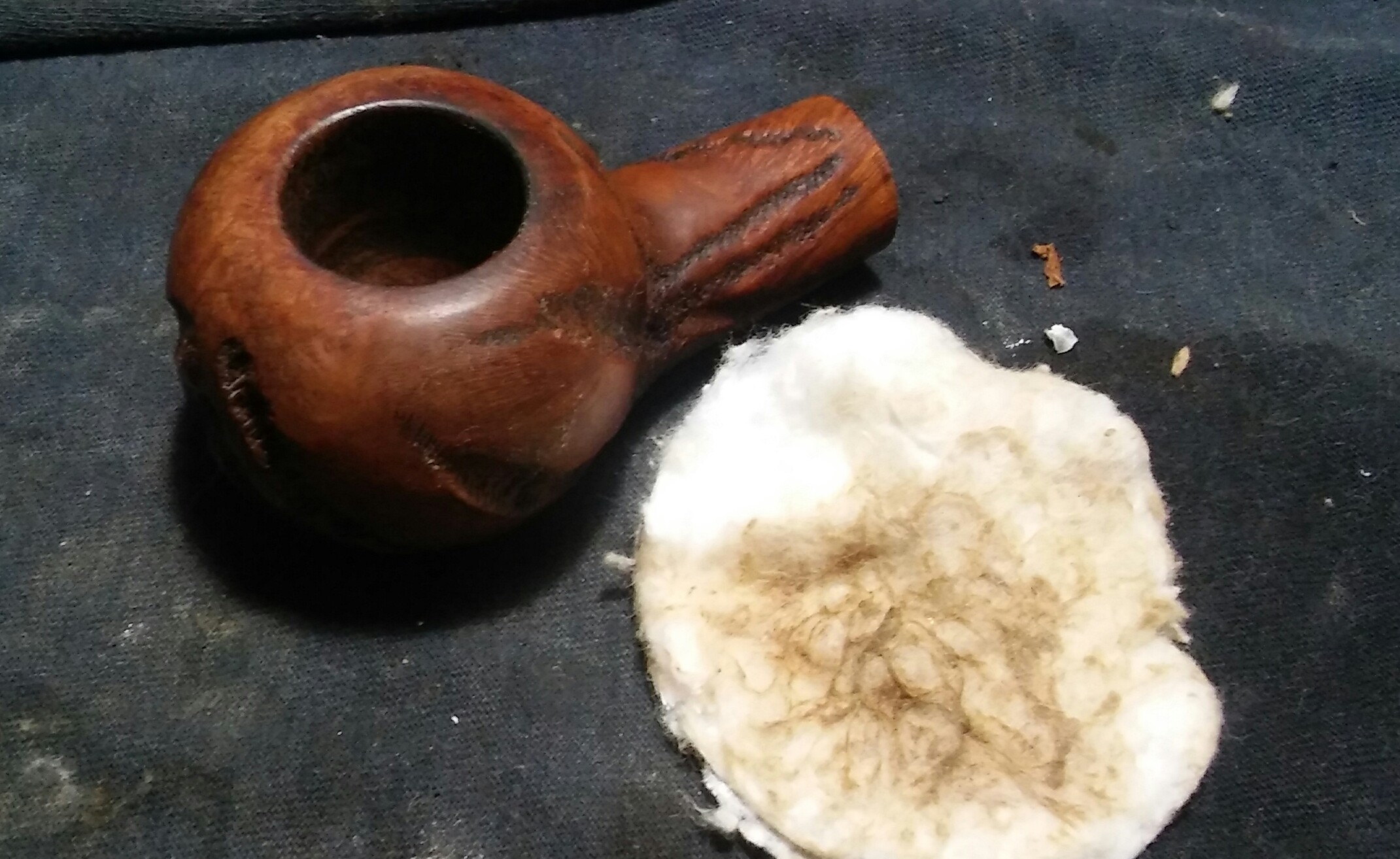
Next I gave the internals a good cleaning. Using EverClear, shank brushes, Q-tips and stiff/soft pipe cleaners. Cleaning until the last pipe cleaner came out as it went in. I now filled the chamber and mortise with cotton balls and added EverClear until the cotton balls were saturated and set it aside for a few hours to absorb the tars and oils. The Lakeland ghost would not give up, the stummel was left over night  with EverClear and cotton balls and hopefully did the trick.
PhotoGrid_1456276643670

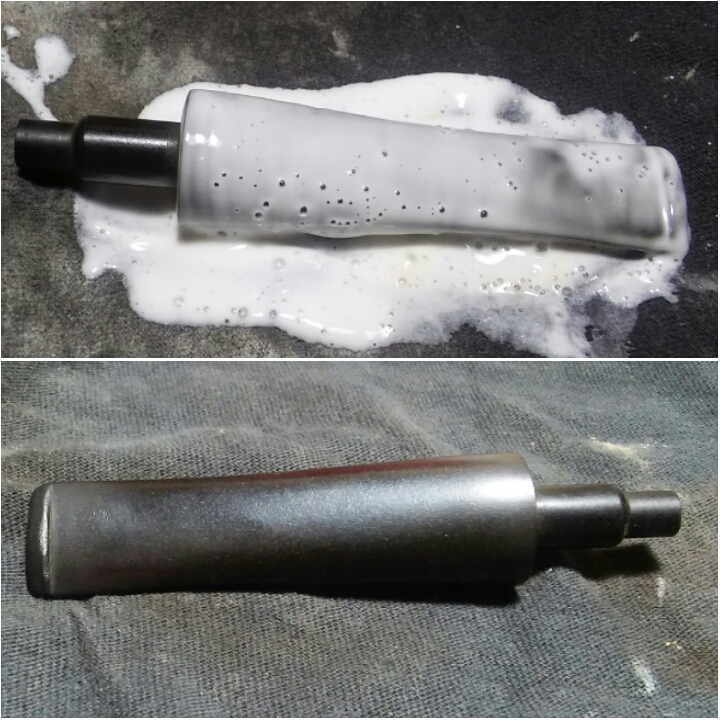
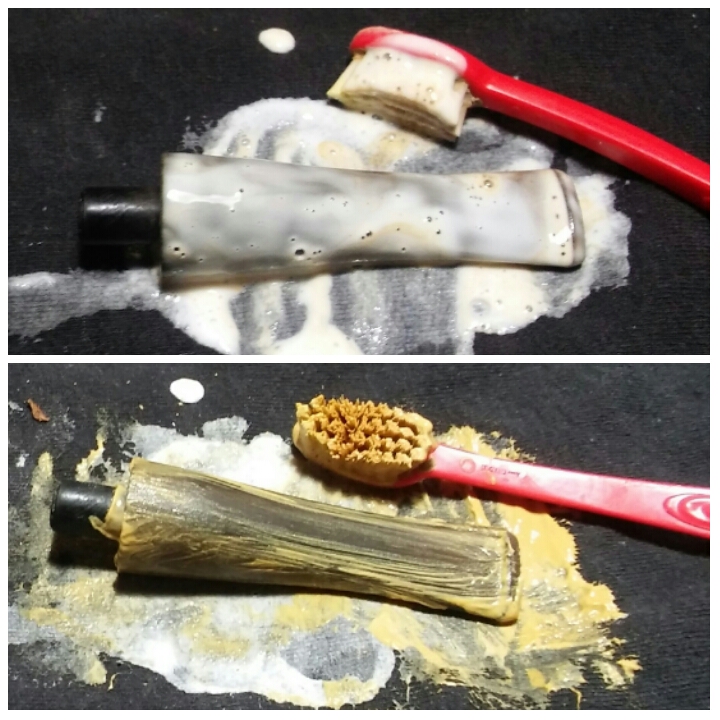
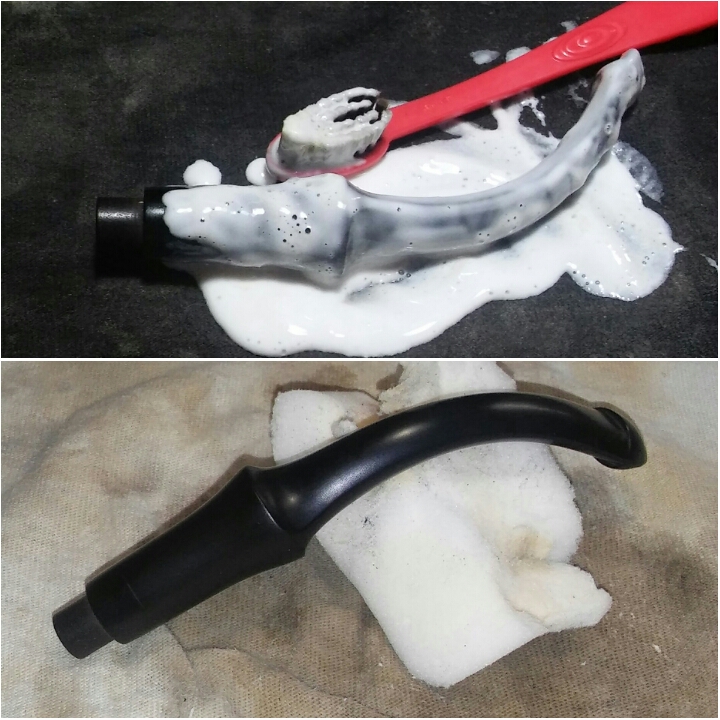
My attention now turned to the oxidized stem. I applied non-bleach Soft Scrub to the stem with a children’s toothbrush and left it aside to penetrate the oxidation. Once the Soft Scrub turns from white to a brownish color its time to introduce the old elbow grease and scrub vigorously with a rag until the oxidation is removed. I finished up with a damp Magic Eraser to remove the leftover oxidation.
PhotoGrid_1456276798588

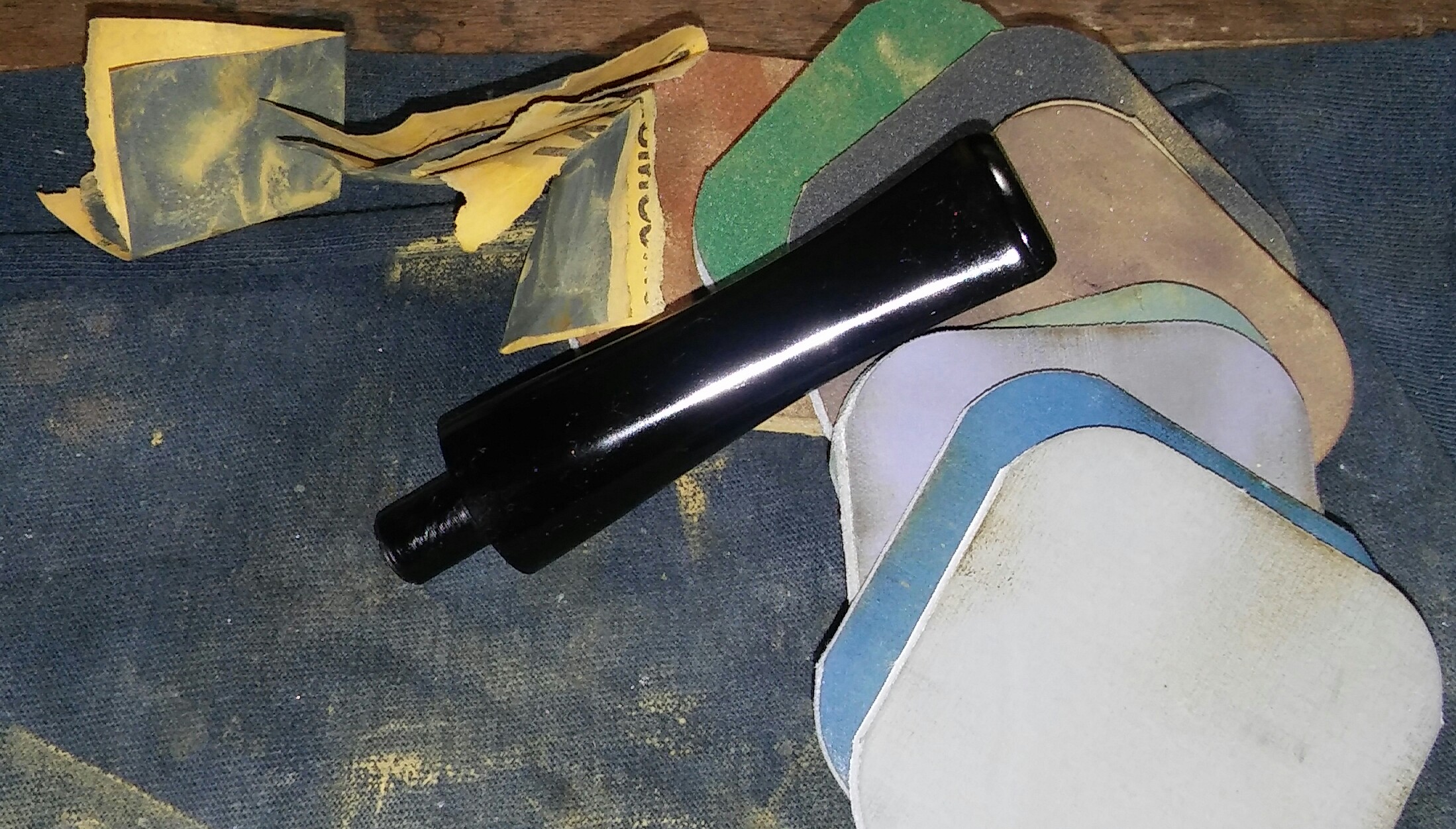
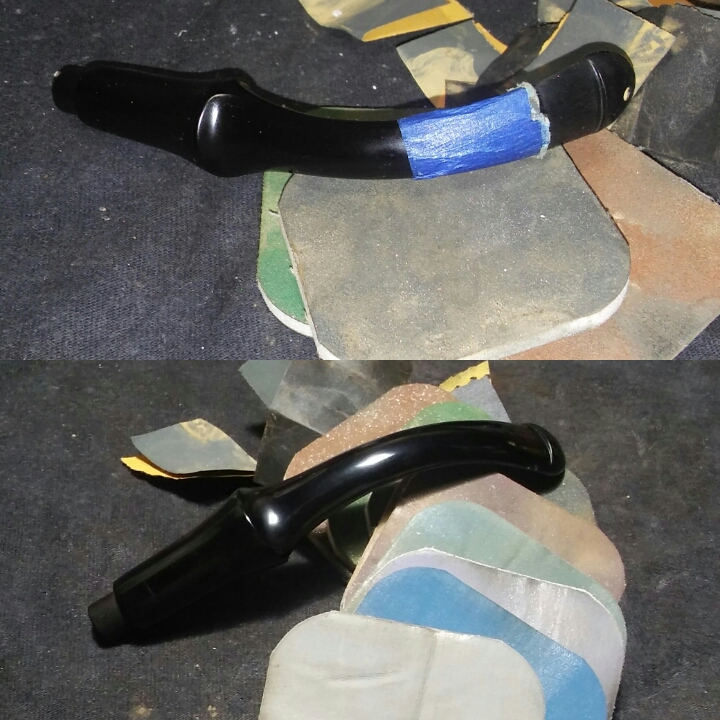
With the oxidation removed I could begin removing the impressions at the bit. I tapped off the stem with blue painters tape just before the P-lip so my rough sanding would remain in one area, the rest of the stem would not need as abrasive grit. Starting with 400 grit sandpaper wet I removed the deep impressions, then working through 800, 1000 grit sandpaper wet, 1500, 1800 micro-mesh wet, 2000 grit sandpaper wet and finally 2400 micro-mesh wet until smooth. Before sanding with the finial six micro-mesh pads I removed the painters tape and dry sanded the entire stem 3200-12000.

PhotoGrid_1456276094304

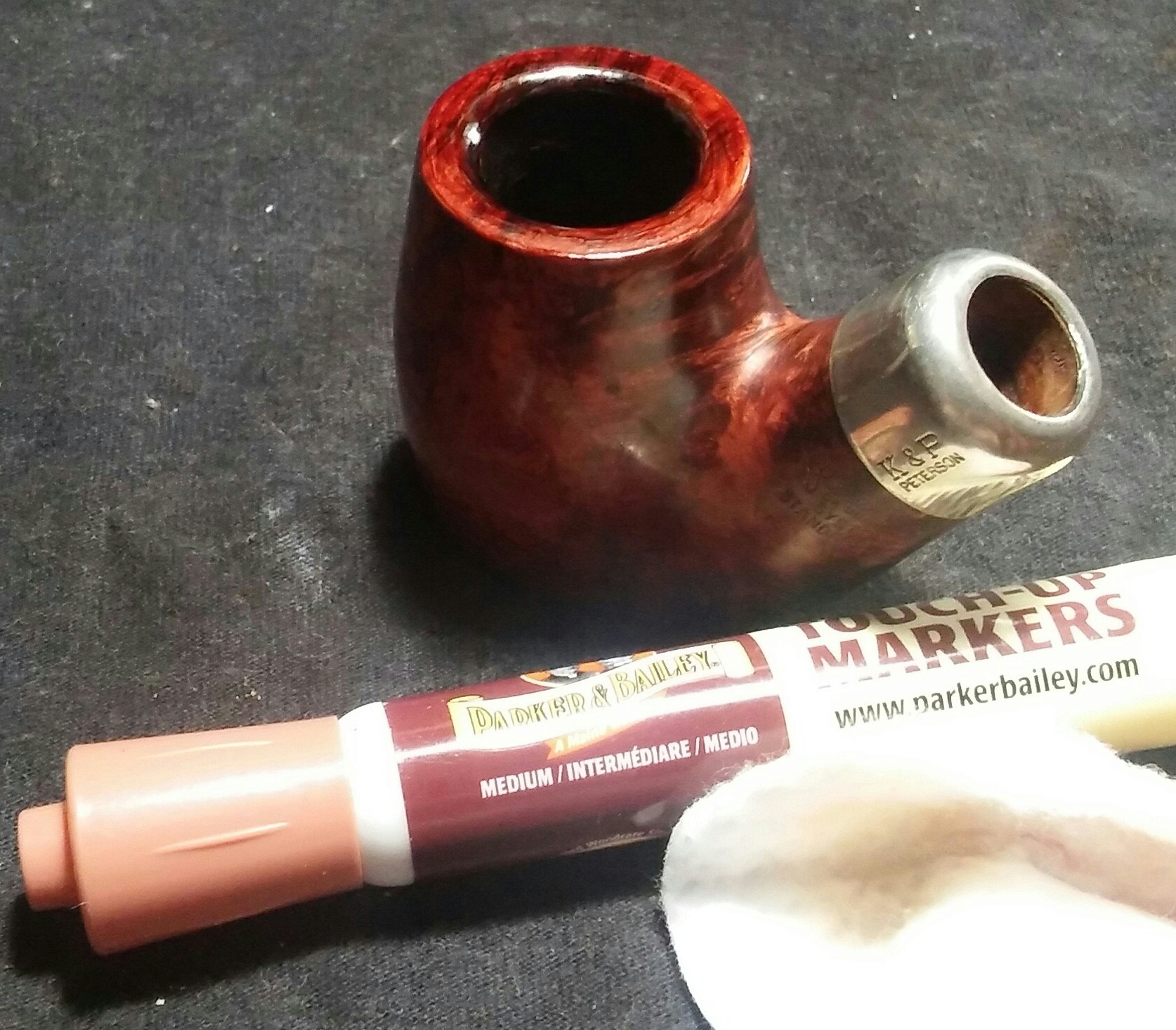
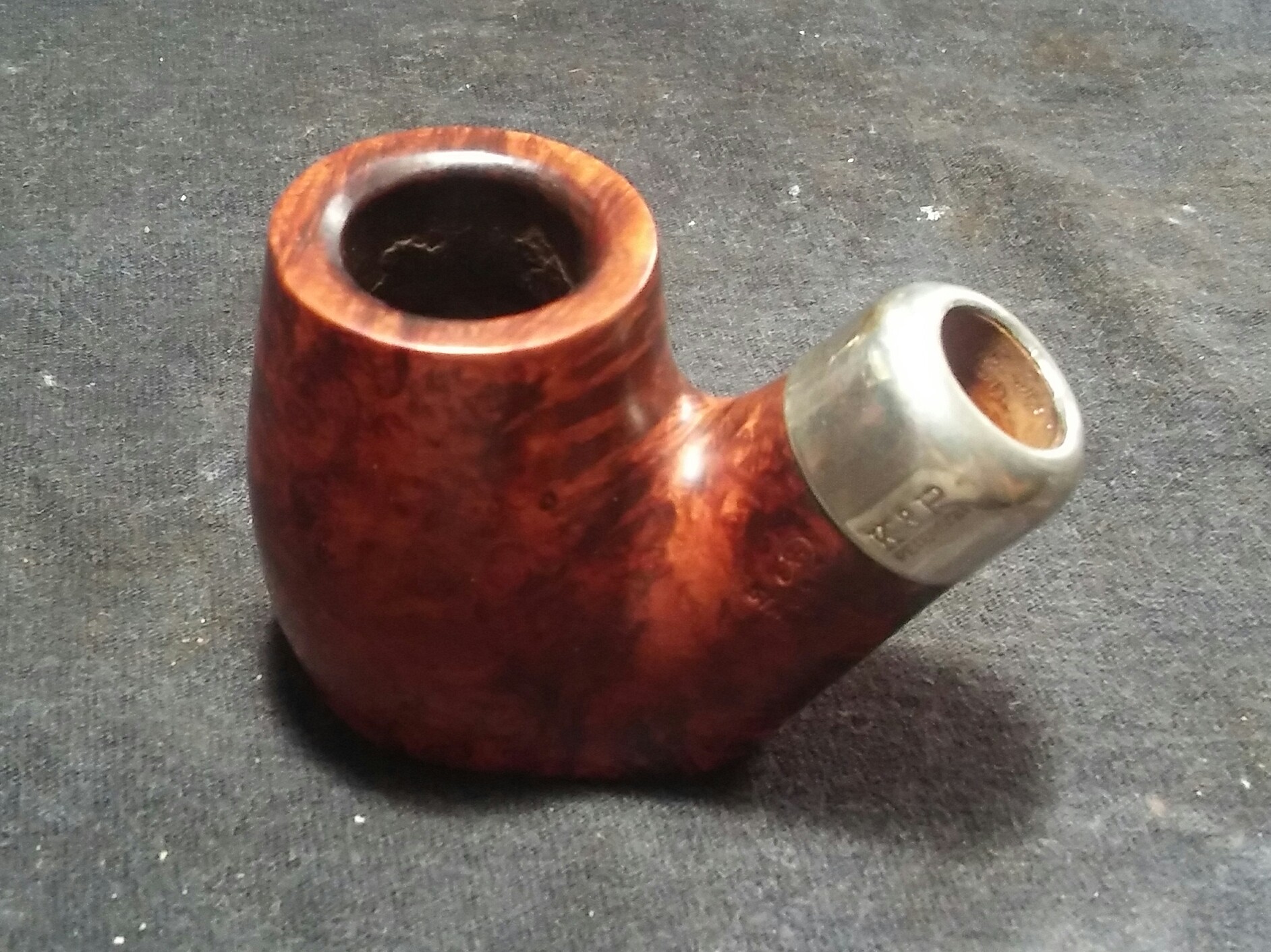
There was one small spot of filler that would need to be removed. To remove I used Method Good For Wood Polish, an X-ACTO knife and a Q-tip, I applied a small amount of the polish with a Q-tip to the filler and left it aside to soften up. Once softened I removed the filler with the X-ACTO knife, I then cleaned the area with a Q-tip and EverClear to remove any oils or debris. I filled the pit with Gorilla Glue and briar dust and allowed it to dry. Once dry I sanded the area with worn micro-mesh until the repair was flush.
20160223_133249~2~220160223_134138~2

The rim and filler spot was left lighter after sanding with  the micro-mesh, using a touch up marker I  was able to blend the faded rim and filler spot into the rest of the finnish. Coloring in the rim and filler spot with the marker allowing to dry and removing the excess with an alcohol dampened rag. In the end I could not exserminate the Lakeland ghost completely but with smoking it will likely dissipate.

Complete.

20160224145519~220160224145634~220160224145641~220160224145909~220160224145653~220160224145823~220160224145836~2

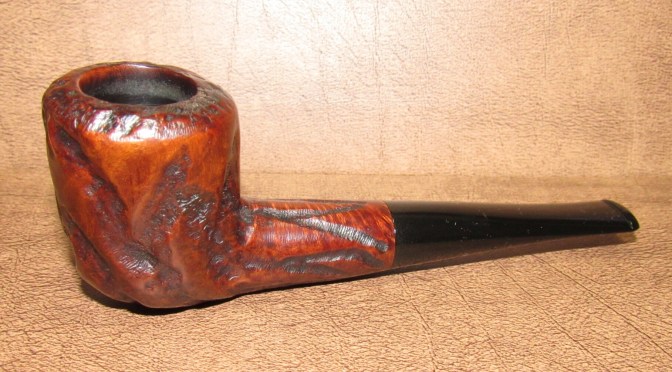
I finished up on the wheel with white diamond, a few coats of carnauba and a microfiber hand buffing. Buffing the stem with blue compound.
Thanks For Taking A Look.

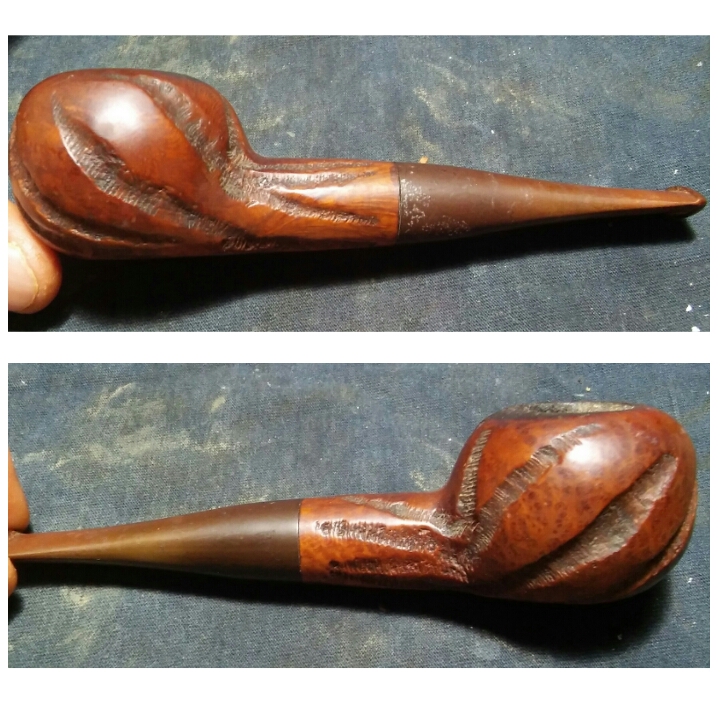
Custom-Bilt Dublin ( Mincer Years )

20151009_1027472_zpsuvvs9drj~2

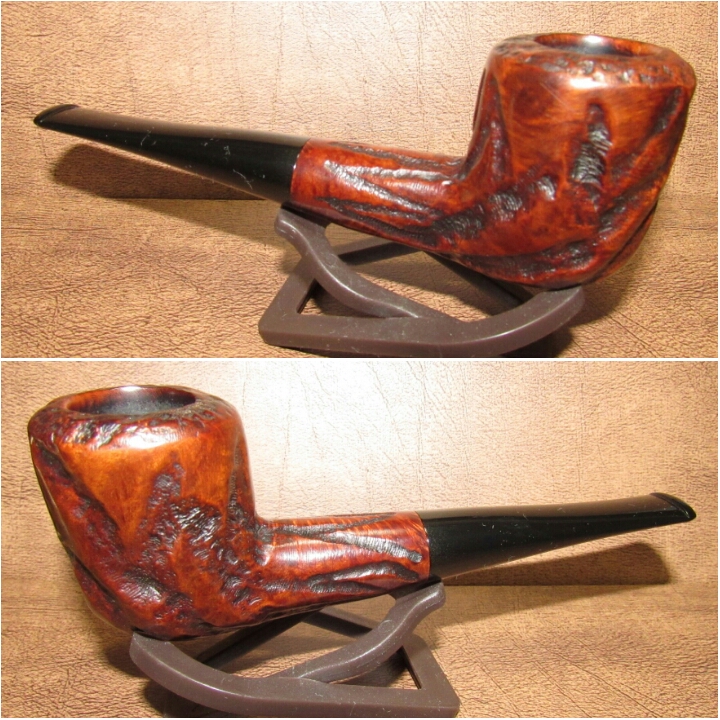
The last of my medium Custom-Bilt refurbs . I have always enjoy the Dublin shape and in the Custom-Bilt carving it looks even better.
As Received.


20160208_005111~2PhotoGrid_1455109004929PhotoGrid_1455108966955

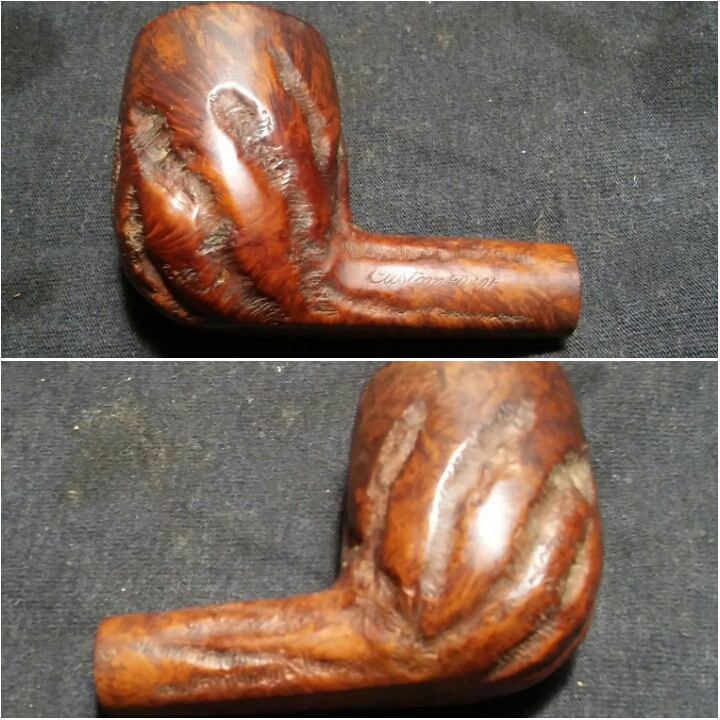
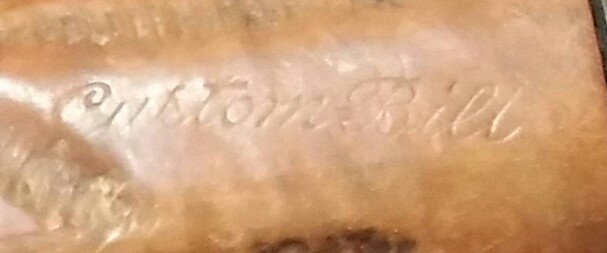
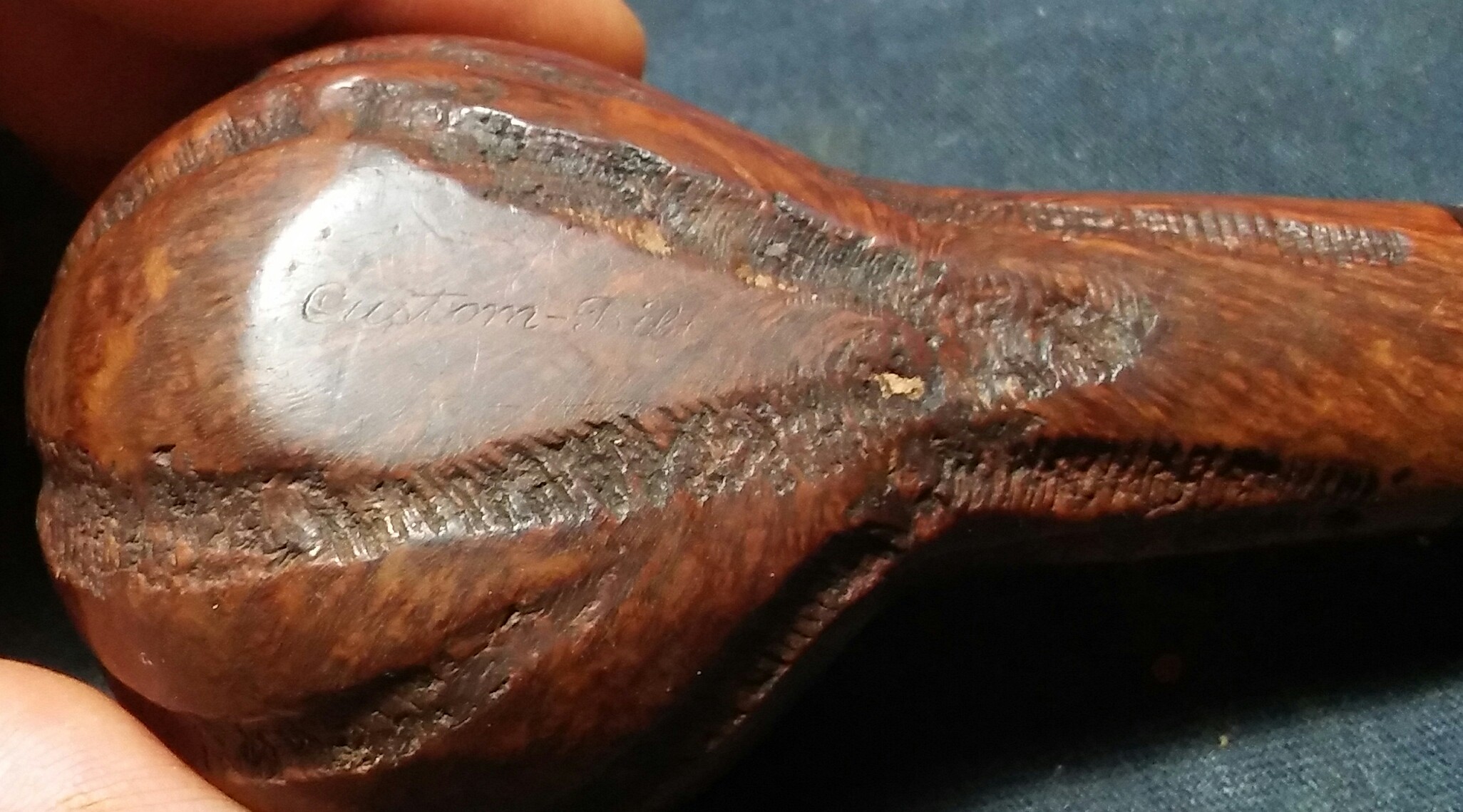
She was in well-loved condition, chatter, a couple of deep tooth impressions, rim tar and char and the nomenclature was worn to almost non-existent. The tell tail Custom is all that’s left .

20160216_174613~2

The chamber was pre-reamed by the previous owner/seller, I smoothed things out with 400 grit sandpaper wrapped around a finger. The chamber was free of damage.

20160208_004922~2~2

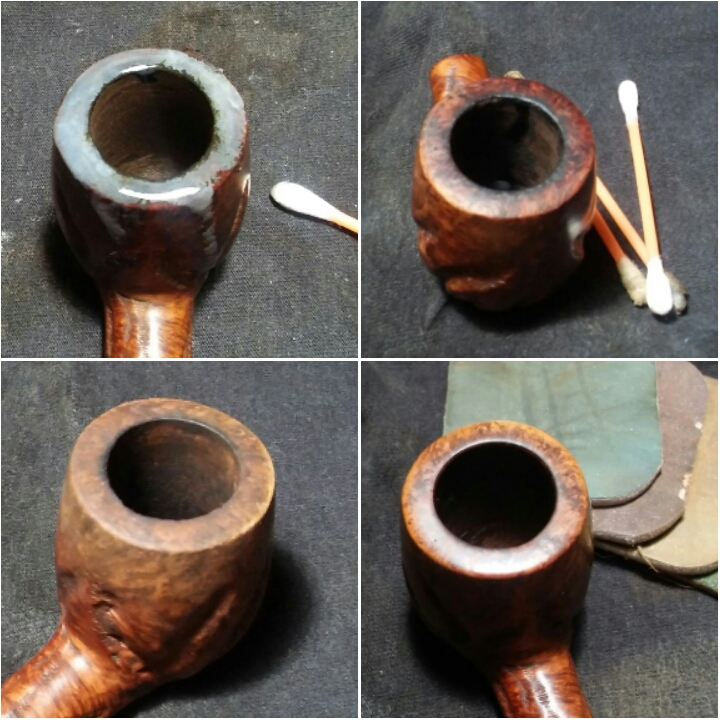
Next I tackled the caked rim I applied a generous amount of Method Good For Wood Polish to the rim with a Q-tip and allowed it to penetrate for a few minutes, removing the build-up with Q-tips and makeup pads. I would repeat this process a few times.

20160216_181101~2

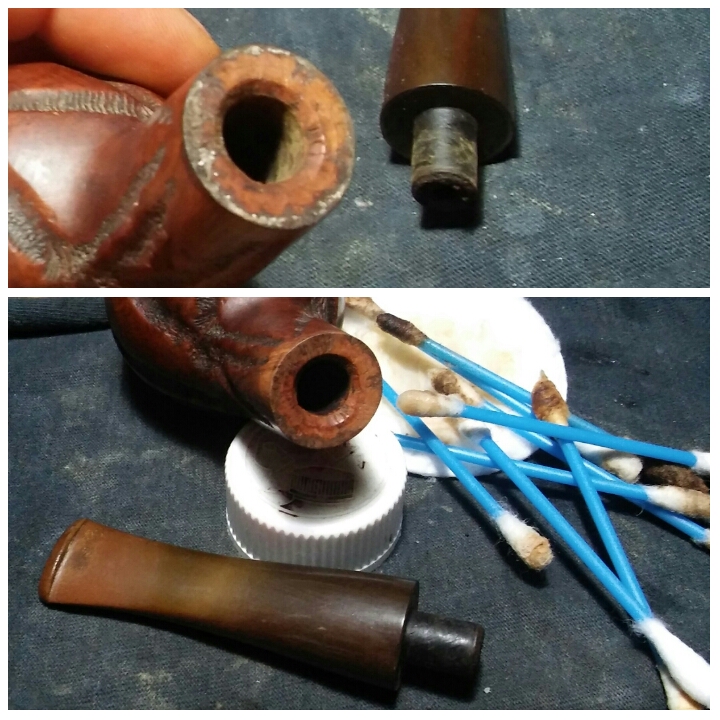
The internals needed attention. Using EverClear, Q-tips , shank brushes and stiff soft pipe  I cleaned the internals of the mortise and chamber ,until the pipe cleaners came out as they went in.

20160216_181436~2

Using an alcohol dampened makeup pad, I wiped down the stummel to remove the dirt and debris.

20160216_182835~220160216_202114~2

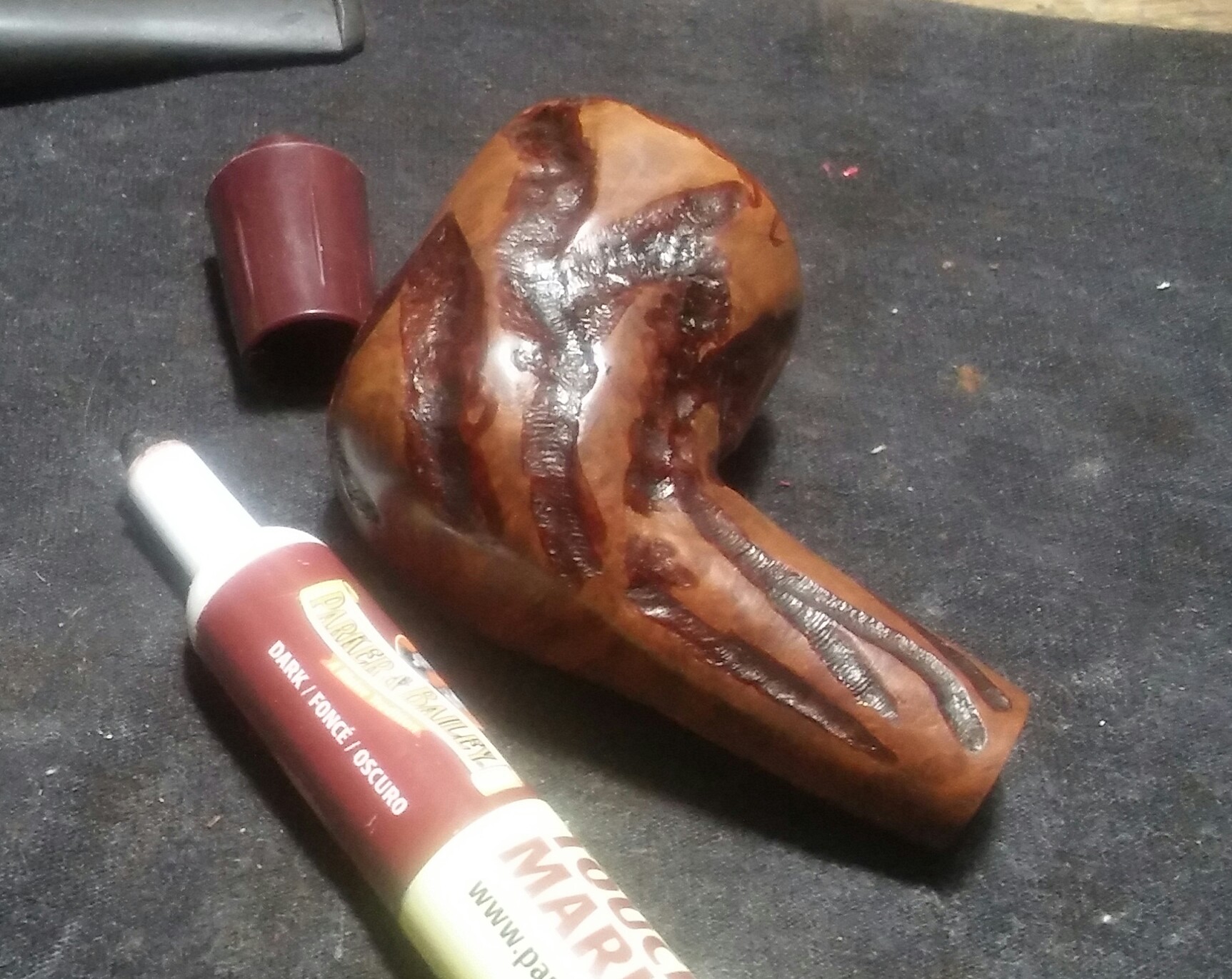
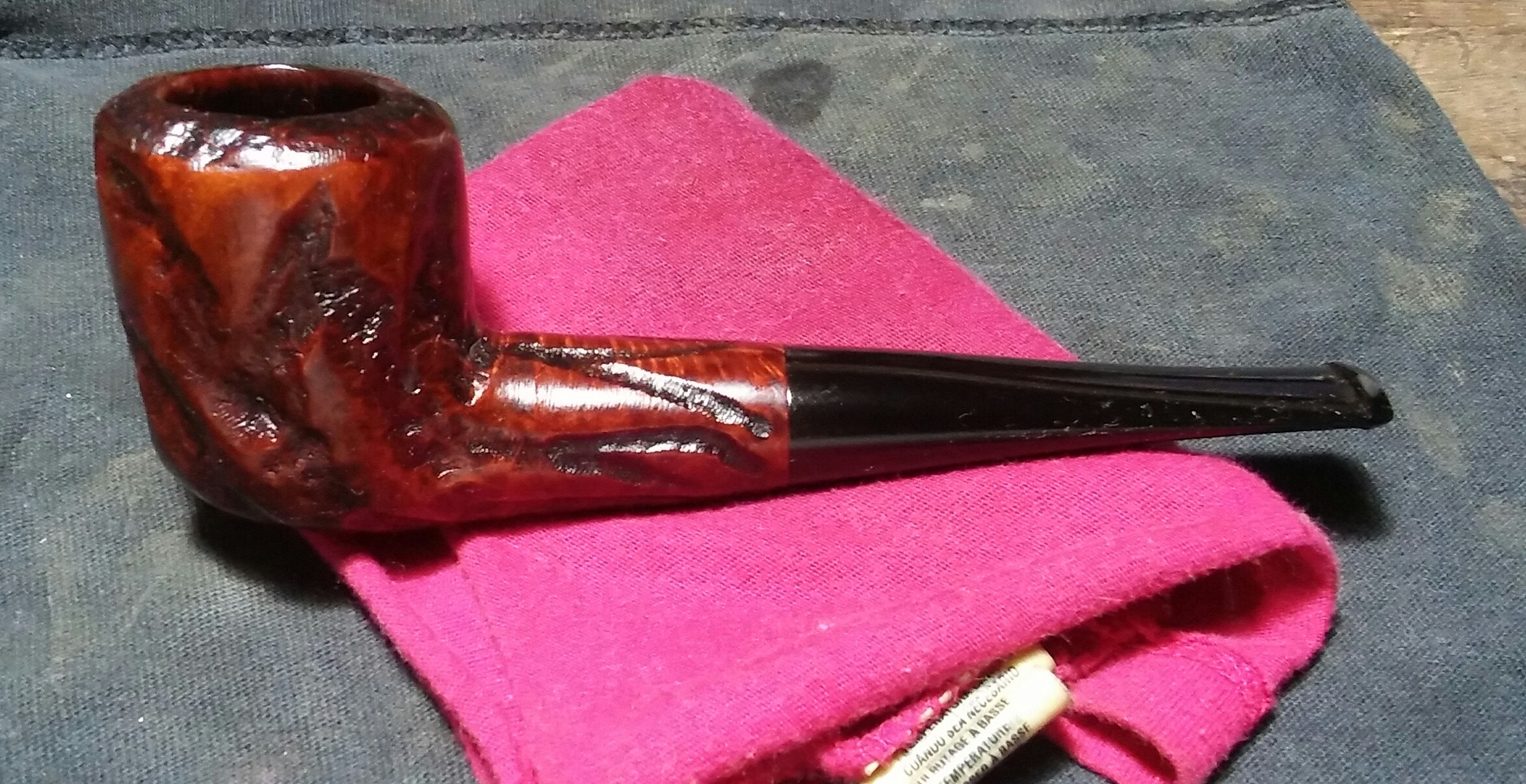
With the stummel clear of dirt and grime, I used a dark touch up marker to highlight the deep gouges, removing the excess with an alcohol dampened makeup pad. I could now move on to the stem

20160217_030058~2

I applied non-bleach Soft Scrub to the stem with a children’s toothbrush and left it aside to allow the Soft Scrub to penetrate the oxidation. Once the Soft Scrub turns from white to a brownish color its time to scrub vigorously with a rag until the oxidation is removed.

PhotoGrid_1455787686198

After the removal of the oxidation there were deep tooth impressions left. I attemped to raise some of the impressions with heat( moving the lighter at all times never leaving it in one spot too long ) to no avail. Instead they would need to be filled.

PhotoGrid_1455787598582

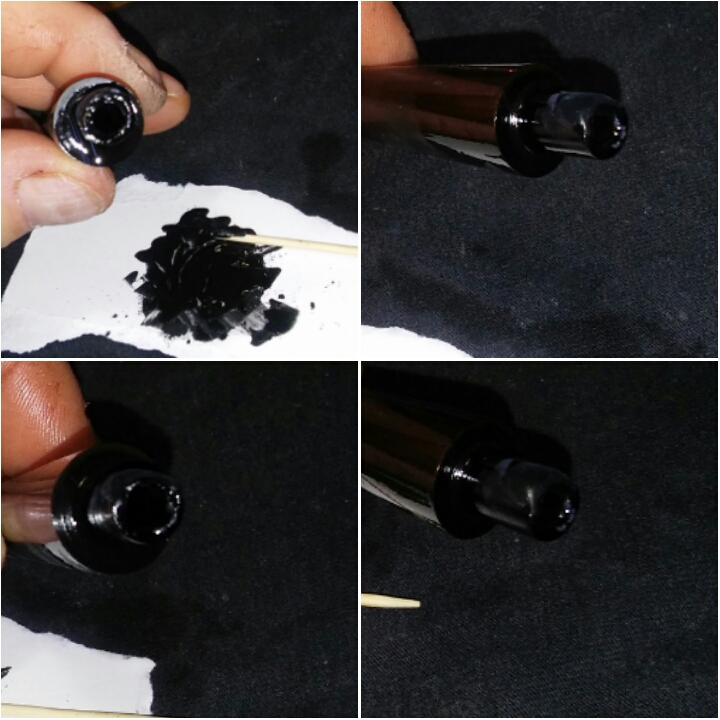
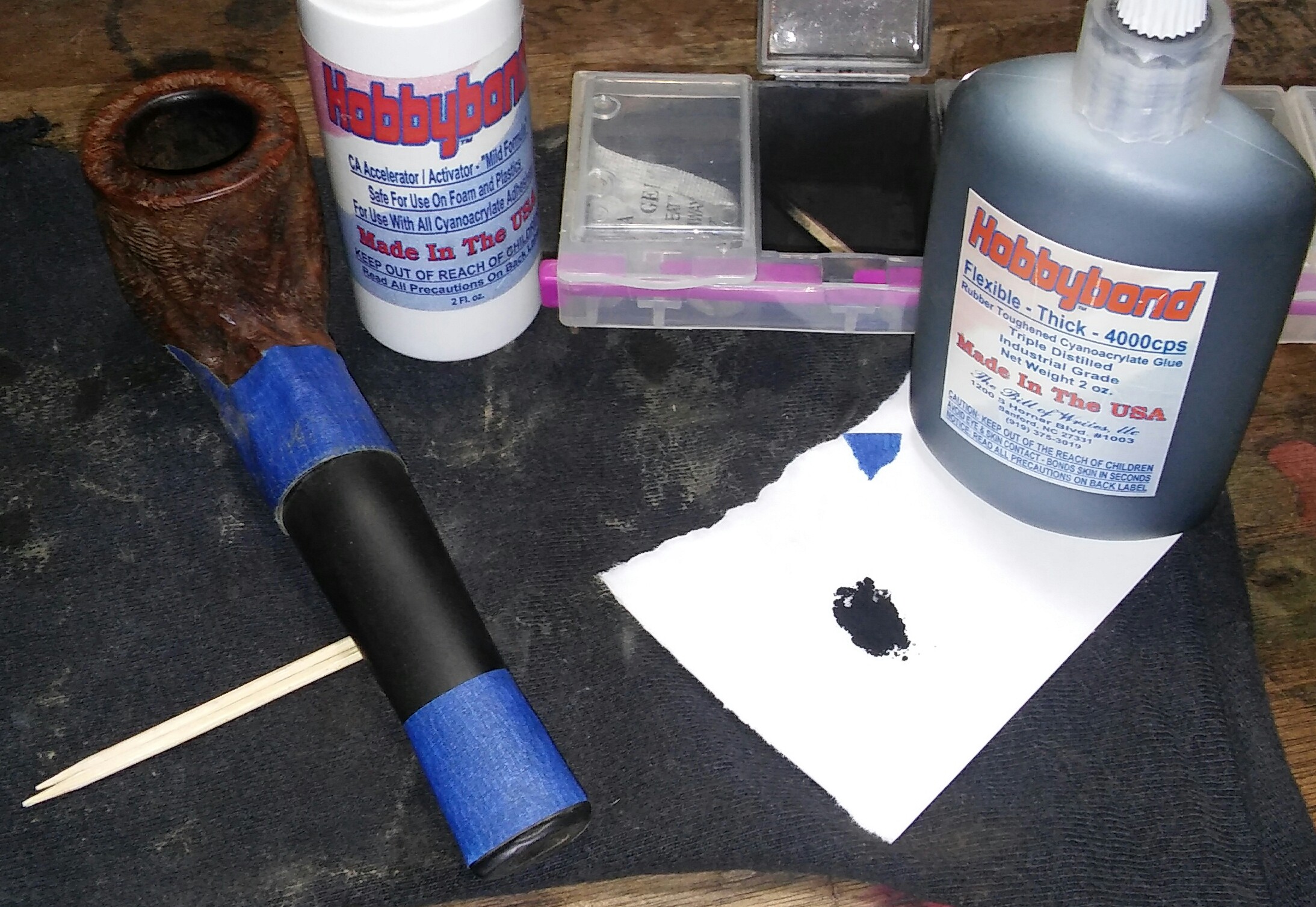
Using thick black CA glue and activated charcoal powder I made a paste. I roughly sanded the area to be repaired with 400 grit sandpaper then wiped down with EverClear. I applied the paste with a toothpick to the impressions and hit it with accelerator to set the repair, I applied pressure with my finger to the patch pressing it into the impression just before it set. I now left it aside to cure overnight.

PhotoGrid_1455787625977

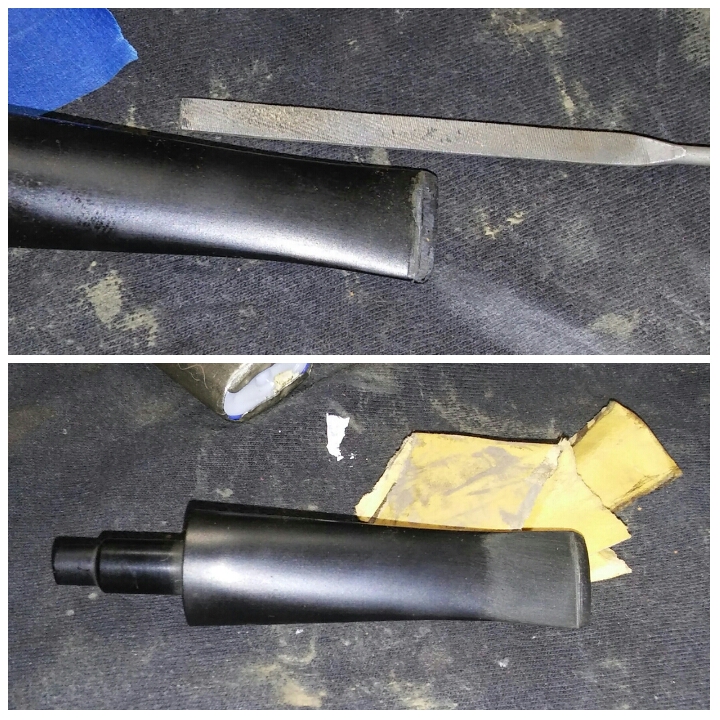
The following morning I began sanding the repair with 400 grit sandpaper wet , with the patch blended into the stem I could move on to the various grits of sandpaper and micro-mesh pads.

20160219_012636~2

Using a washer between the stummel and stem to keep my sanding in one area, I now ran the stem through the various grits of sandpaper and micro-mesh pads starting with 800 grit sandpaper wet, 1000 grit sandpaper wet, 1500 mesh wet, 1800 mesh wet, 2000 grit sandpaper wet and 2400 mesh wet , then 3200- 12000 micro-mesh dry.

20160219_013135~2

Before hitting the wheel I applied Howard’s Butcher Block Conditioner with a rag and let it penetrate for a few minutes, removing the excess with a clean rag.

Complete

20160221045755~220160221050041~220160221050052~2PhotoGrid_1456042153759PhotoGrid_1456042138342

I finished up on the wheel with white diamond, a few coats of carnauba and a microfiber hand buffing. Buffing the stem with blue compound.

Thanks For Taking A Look.


Brebbia Clean Up

Screenshot_2016-02-20-05-12-10~2~2

Happy International Pipe Smoking Day to all my friends, readers and fellow bloggers. For the day I wanted something new, well new to me . She came in on Friday just in time for a Saturday puff. The Brebbia Fat Bob is a pipe I’ve been in search of in my price range for two year’s. Now I’m unsure if that’s what I have here but if it’s not it’s a close match. The pipe itself is unmarked but the stem has the Brebbia inlay. I have seen other unmarked Brebbia’s in the past made for private B&M’s.
As Received

PhotoGrid_1455960948669

I got a little ahead of myself with this refurb and began working without stopping to take before and after photos, the photo above is from the auction. It was listed as clean and ready to smoke apparently my standard’s are a little higher than others. The pipe was badly reamed ( out of round ) and the chamber had the start of a burn out. The chamber and mortise were still holding tars and oils, the black finish was worn in spots. The stem on the other hand was spotless.

20160220_010819~220160220_010829~2

The above two photos are of the rim and chamber burn. The right side of the rim was thicker then the left side and the chamber was reamed into an oblong shape. I had already begun removing the worn finish in my excitement starting with EverClear and then moving to acetone, I would normally ream the chamber first.

20160220_012636~2

The chamber was reamed by the seller for the most part back to briar exposing the burn in the right side of the chamber. I sanded the chamber instead of reaming with 220 grit sandpaper and then 400 grit sandpaper, sanding the right side of the chamber and removing the burnt area completely. There was more than enough chamber thickness to do so.

20160220_010851~220160220_013855~2

Next I moved onto the uneven rim. Using a round side needle file and 220/400 grit sandpaper I began reshaping the rim.

20160220_021526~2

I decided the rim would pop more if it were smooth and natural, I sanded the rim with 400 grit sandpaper and finished with 800 grit sandpaper.

20160220_023718~2

I now cleaned the internals of the chamber, mortise and stem with EverClear, Q-tips, shank brushes and stiff soft pipe cleaning until the pipe cleaners came out as they went in.

20160220_024348~2

 With the old Finnish removed I re-stainded the stummel with dark brown Fiebing’s leather dye hitting with a lighter to set the set the stain. Now this is where I got over focused and did not take photos of my process. I removed the excess stain with an alcohol dampened rag and then sanded the high spots to lighten the stain, leaving the darker stain in the lower blasted areas of the stummel, wiping the stummel down with an alcohol dampened rag once more .

20160220_033252~2

I gave the stummel a coating of Howard’s butcher block conditioner before hitting the wheel, removing the excess with a clean rag.

Ready For IPSD

20160221014451~2PhotoGrid_145603064681720160221013545~220160221013504~220160221013611~2PhotoGrid_1456030663453

Finished her up on the wheel with white diamond, a few coats of carnauba and a microfiber hand buffing. Buffing the stem with blue compound.

Now with a beautiful 54 degree February afternoon in N.Y. I’ll sit and enjoy my work and celebrate my wife’s birthday as well. Keep your chambers full and your hearts happy.
“May your matches always light and your tongue never bite”

Finished Product…

An impressive piece of work from Clint of http://pipescoundrel.com . Check out his blog to see his work from conception to completion. Looking forward to seeing more from him.

Clinthulhu's avatarpipe scoundrel

12717618_1112718185440037_4468138254427787388_n

Well here it is… The final product of about 20+ hours of drawing dots. After having been away from doing anything “artistic” for a number of years I think it turned out pretty well. I had a lot of fun with this one and I’m already starting on my next project. I’m hoping in the next few months I can also sit down with some oil paints and see how much I’ve forgotten about that as well.

I picked up a frame for this over the weekend and despite the crappy picture it looks pretty damn nice in the frame if I do say so myself. I’m going to have a hi-rez scan done so that I can make a few prints but I’m probably going to give the original to a friend. Just thought I would share here for anyone who is interested in how it turned out.  12743568_1113167278728461_8755580862501099677_n

View original post

Custom-Bilt Billiard

PhotoGrid_1454484691598~2
Many of the Custom-Bilt pipes in my collection are on the larger side but lately the medium size Bilts have caught my eye. This billiard is the first I’ve seen and I couldn’t wait to see her finished.
As Received.
20160205_232622~2~2PhotoGrid_1454785733634PhotoGrid_145478579667320160205_225510~2
She was in rough shape when I received her.  Most disappointing was the cracked tennon,  thankfully it still had its little rubber filter insert and I thought it might be salvageable.  The bit had deep tooth impressions that almost punched through. The button was worn down and the stem was oxidized. The rim was caked with dirt,oils and char. The chamber had a thick crumbling cake and the mortise was plugged with old tobacco and tars.
20160205_233122~2
I started with my Pipnet Reamer and the smallest attachment working up to the second largest, finishing up with 400 grit sandpaper wrapped around a finger. The chamber was well-preserved from the thick cake.
20160205_233117~2PhotoGrid_1454786184020
Next I tackled the caked rim. I applied a generous amount of Method Good For Wood Polish to the rim and set it aside to penetrate the build-up for a few minutes removing the build-up with Q-tips , I would repeat this process a few times. After the removal of the rim build-up There were a few dings in the rim. Using a household iron on medium high/ heat and a damp rag I steamed out the imperfections working in intervals until the imperfections were almost gone. I finished up with worn micro-mesh until the rim was free of darkening and dings.
PhotoGrid_1454786065688
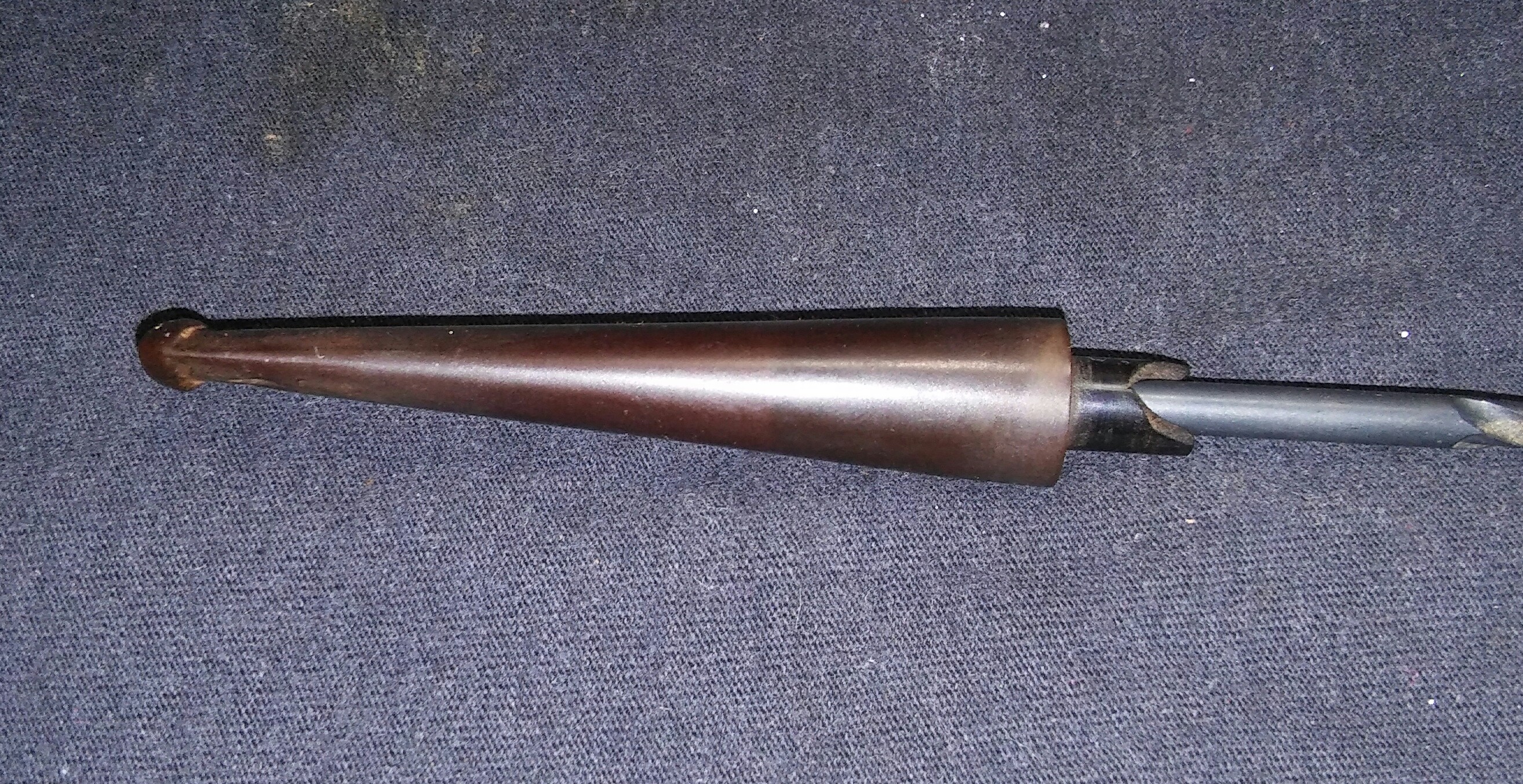
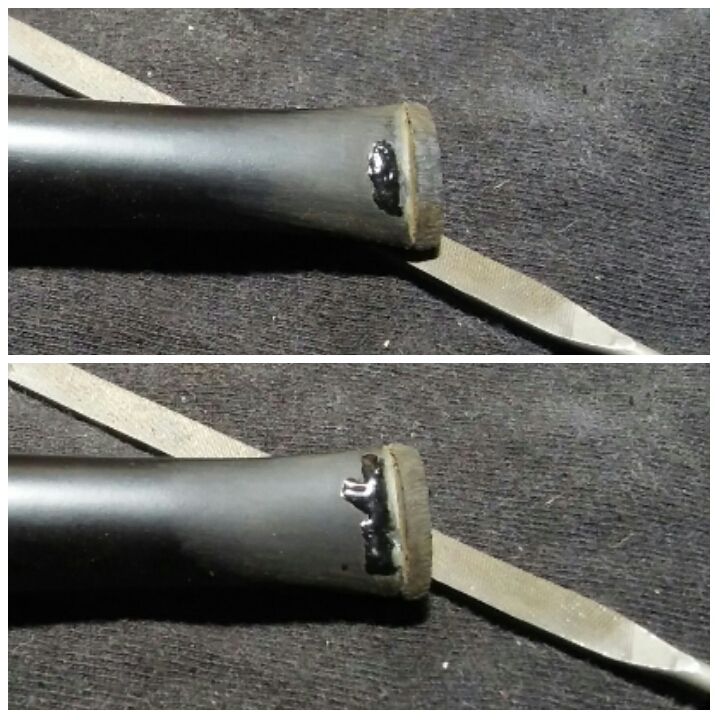
Next was the cracked tennon, I fit The opposite end of a 3/16 inch drill bit into the tennon, making sure I had a tight fit.I mixed thick black CA Glue and activated charcoal power into a paste I then applied a generous amount of chapstick to the drill bit end so the CA Glue would not adhere to the bit but would adhere to the tennon only. I applied a thin layer of the CA Glue mixture to bridge the gap where the missing tennon piece was , hitting it with accelerator to set up the glue, I removed the drill bit at this time.
20160205_230850~2
With the drill bit removed I now applied several layers of the CA Glue mixture to build up the missing section of the tennon, spraying with accelerator in between each layer I added, until I had a close match to thickness of the existing tennon.
PhotoGrid_1454785928195
Once my thickness goal was reached I left the tennon to cure for a few hours. After curing I worked the new tennon with needle files carefully removing the excess glue until I had a close match to the remaining section of the tennon.
PhotoGrid_1454786110861
I now worked the new tennon with 400 grit sandpaper until I had a close fit between mortise and tennon, making my finishing adjustments with 1000 grit sandpaper until I had a snug fit between mortise and tennon. I then re-worked the inner of the tennon with a round needle file and rolled-up 1000 grit sandpaper so I could re-fit the rubber filter insert.
PhotoGrid_1454785701337
This Custom-Bilt had two spots of pretty visible filler. Using Method Wood For Good Polish to soften up the filler and a X-ACTO knife, I removed the filler.
PhotoGrid_1454786256072
I cleaned the area to be repaired with EverClear and Q-tips. I filled the pits with Gorilla Glue and briar dust and left aside to dry. Once dry I removed the excess glue and dust with worn micro-mesh until the repair disappeared into the rustication.
20160206_015445~2
I used a  dark furniture marker to darken the rusticated area’s of the stummel to further guarantee my repair would stay hidden.
20160206_033127~2
With the outer of the stummel complete I moved to the internals, cleaning the mortise and chamber with EverClear, Q-tips, shank brushes and stiff/soft pipe cleaners, cleaning until the last pipe cleaner came out as it went in.
PhotoGrid_1454787172750
I attempted to raise some of the deep tooth impressions with heat, some of the button raised but most of the impressions would still have to be filled.
PhotoGrid_1454831257785
Next the stem oxidation, I applied a generous amount of non-bleach Soft Scrub to the stem with a children’s toothbrush and left it aside to penetrate the oxidation. Once the Soft Scrub turns from white to a brownish color its time to scrub vigorously with a rag until the oxidation is removed.
PhotoGrid_1454830754816
The deep tooth impressions had to be repaired, I roughly sanded the area of repair with 400 grit sandpaper and wiped down with EverClear. I mixed thick black CA Glue and activated charcoal power into a paste .
PhotoGrid_1454830822289
I applied the paste to the impressions and worn button using a toothpick hitting it with accelerator to set the patch, I set the stem aside now to cure overnight. The following morning after the paste had time to cure, I used needle files and sandpaper to remove the excess glue until I had a uniformed shape.
20160207_022716~2
I sanded the entire stem with 400 grit sandpaper wet to remove the file marks and then moved on to the various grits of sandpaper and micro-mesh. 1000 grit sandpaper wet, 1500 mesh wet, 1800 mesh wet, 2000 grit sandpaper wet and 2400 mesh wet. Runing though the remaining micro-mesh pads dry 3200-12000.
20160207_022757~2
My final step for all my Custombilt pipes is to apply Howard’s butcher block conditioner to the stummel before buffing. I apply Howard’s butcher block conditioner with a rag and allow it to penetrate for a few minutes hand buffing off the excess with a clean rag.
Complete.

PhotoGrid_145493984631720160208104845~220160208104522~220160208104240~220160208104306~220160208104315~2

I finished her up on the wheel with white diamond, a few coats of carnauba and a microfiber hand buffing Buffing the stem with blue compound.
Thanks For Taking A Look.

CUSTOM-BILT / CUSTOMBILT CRAZY

PhotoGrid_1454654935825
    Collecting focus- everyone needs one, right ? I’ll be the first to admit I might have a problem, but when I first started I had no direction, just buying up lots of estate pipes Willy Nilly. Two years ago I had over 300 hundred pipes, a few of them Custombilt ( before the bug really bit ) but nothing to right home about, nothing eye-catching, no real attachment. So my first step was to unload the clutter, donating and selling off what didn’t belong. I’ve never been a fan of dainty pipes, I’m a big guy and well it just looks silly, its kinda like
Screenshot_2016-02-05-02-48-10~2
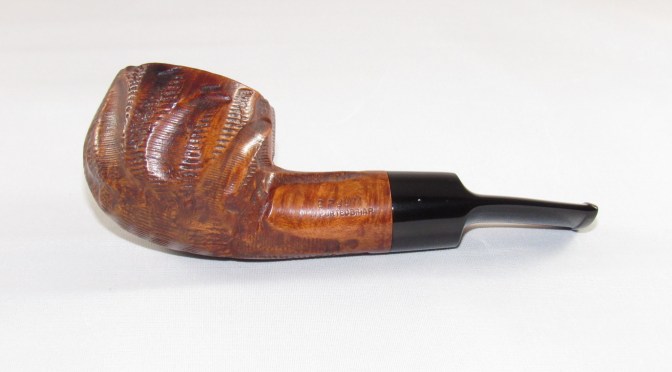
So smaller pipes would go first. What was left was starting to grab me. My introduction into large pipes began with Ropp cherrywood pipes, the rustic look originally sold me, being from the Adirondacks it seemed fitting but with time things loosened up at the shank and bowl. I have one un-somoked large cherrywood Ropp left. Than came Tom Howard and B P Jum  pipes, this was the turning point, large and interesting, fit my face pipes. The only draw back was the overuse of filler in both Howard’s and Jum pipes, riddled like bullet holes. Then finely Custom-Bilt it was like being a kid again I couldn’t resist large, ugly and roughly carved. I had to get them all, each one no mater how closely they resemble one another are completely different. The next few refurbs will be Custombilt pipes as I have many waiting in line to be revived. I need to take photos of my complete collection, I’m not really sure how many I have at this point. 
Heres one more.
20160131_161217~2~2PhotoGrid_1454296771399PhotoGrid_1454296807572PhotoGrid_1454296785367
Overall she was in good condition,  uneven cake, a chip out of the side of the bowl, stem oxidation and faded finish.
PhotoGrid_1454643557763
I started with my Pipnet Reamer and the smallest attachment and working up to the second largest. The chamber was free of burn out or pitting, I smoothed things out with 400 grit sandpaper wrapped around a finger.
PhotoGrid_1454643587961
With the chamber reamed I moved to the rim build up, the rim was built up with tars and char. I applied a generous amount of Method Good For Wood Polish to the rim and set aside to penetrate the build-up for a few minutes. Using Q-tips I removed the build-up, I would repeat this process a few times.
20160204_133121~220160204_145542~2
To remove the char and darkening I used worn micro-mesh until the rim darkening was faded. I now cleaned the internals of the stummel and stem with EverClear, Q-tips, shank brushes and stiff/ soft pipe cleaners. Cleaning the mortise and chamber until the pipe cleaners came out as they went in
20160204_134801~2
I gave the stummel an alcohol wipe down with EverClear and makeup pads to remove the dirt and debris
PhotoGrid_1454643494800
The chip in the side of the bowl would be repaired with Gorilla Glue and briar dust. I cleaned the area of repair with EverClear, Q-tips and let dry. I filled the crack with Gorilla Glue and briar dust and allowed it to dry, I removed the excess glue and dust with worn micro-mesh.
20160204_171320~2
I stained the repair patch with a dark furniture marker allowed it to dry and removed the excess stain with an alcohol dampened rag.
PhotoGrid_1454643517737
Now for the stem oxidation, I applied a generous amount of non-bleach Soft Scrub to the stem with a children’s toothbrush and set aside to penetrate the oxidation.Once the Soft Scrub turns from white to a brownish color its time to introduce the old elbow grease and scrub vigorously with a rag until the oxidation is removed.
20160204_204435~2
With the oxidation removed I could now run it though the various grits of sandpaper and micro-mesh pads. 1000 grit sandpaper wet, 1500 mesh wet, 1800 mesh wet, 2000 grit sandpaper wet and 2400 mesh wet. The remaining micro-mesh pads dry 3200-12000.
20160204_172639~2
I don’t typically stain my Custom-Bilt pipes but I thought I’d give it a go. Using a dark furniture marker for the rusticated area’s of the stummel and a lighter color marker for the rest of the stummel, removing the excess stain with an alcohol dampened rag.

Complete.

PhotoGrid_145493981620420160208104819~220160208104553~220160208104627~220160208104706~2

Finished her up on the wheel with white diamond, a few coats of carnauba and a microfiber hand buffing Buffing the stem with blue compound.
Thanks For Taking A Look.

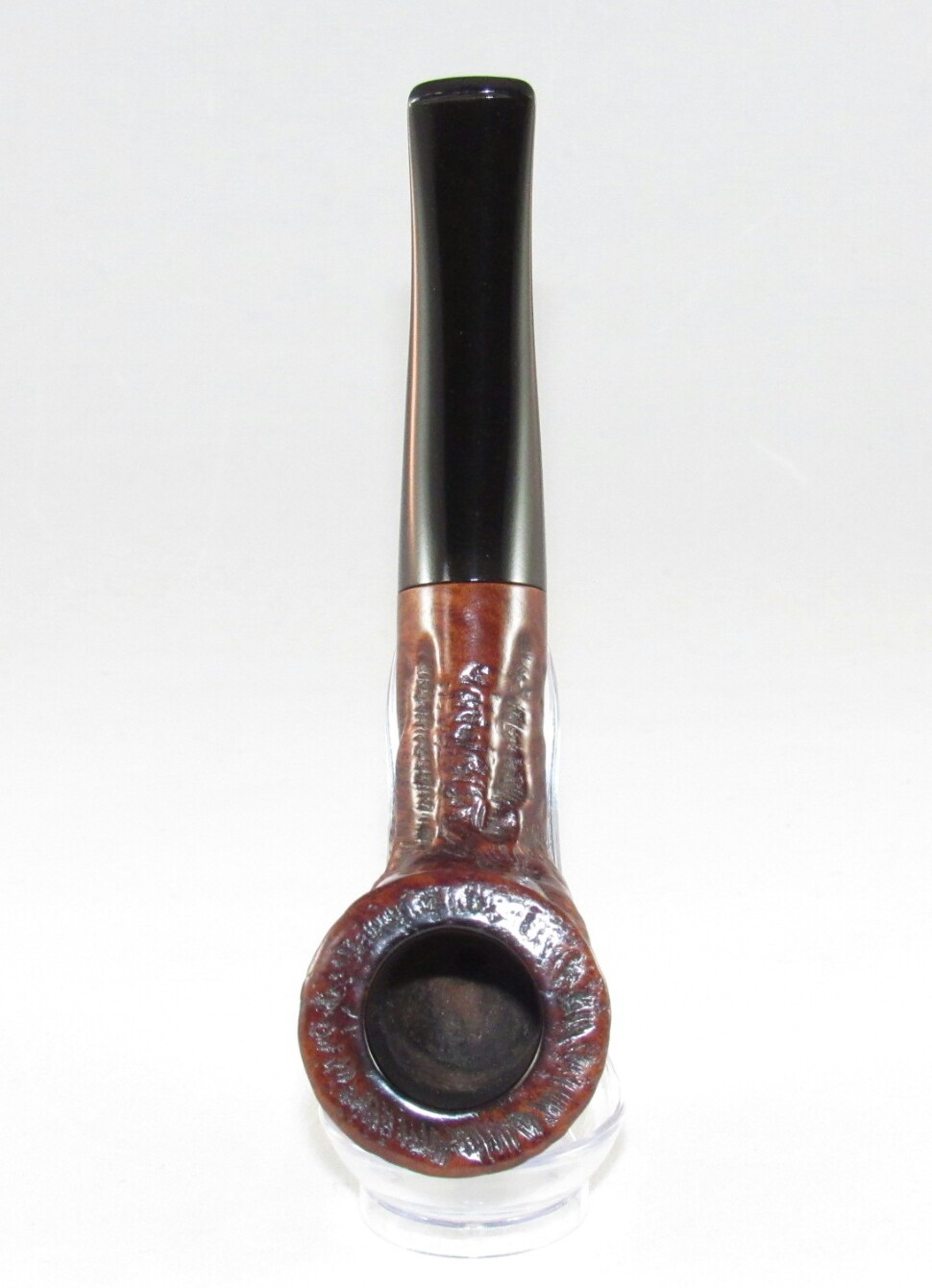
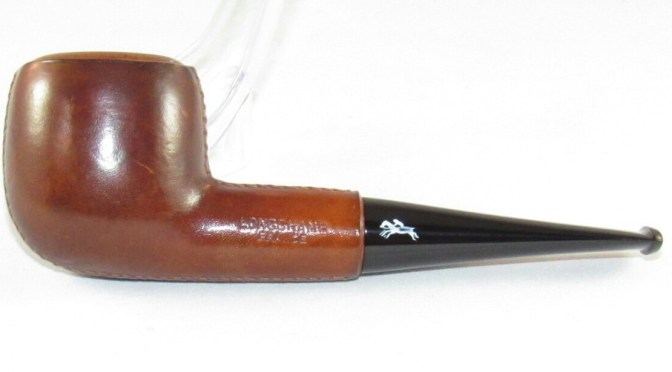
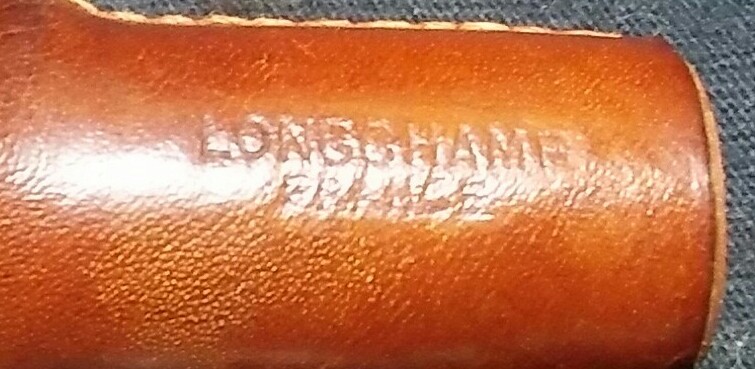
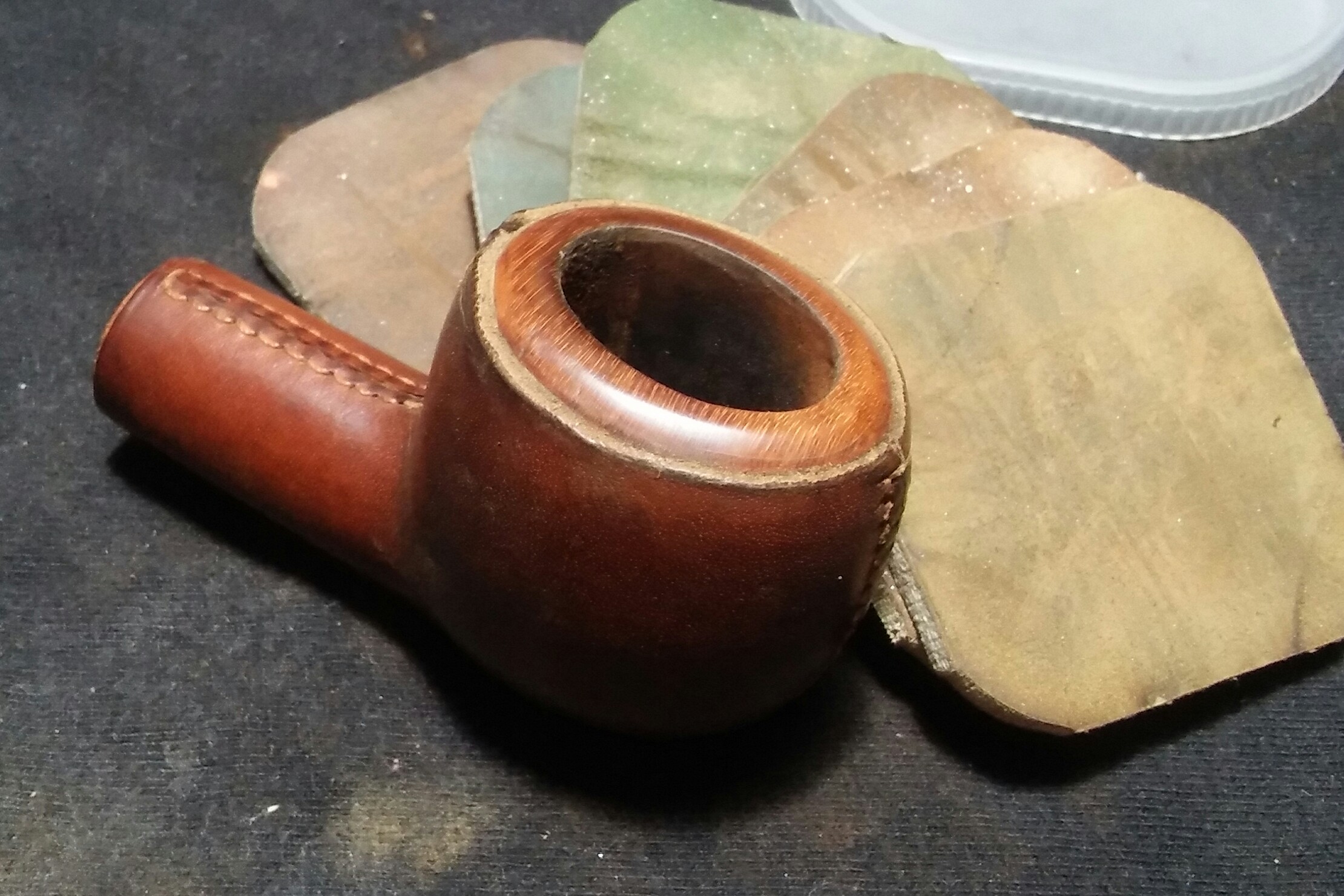
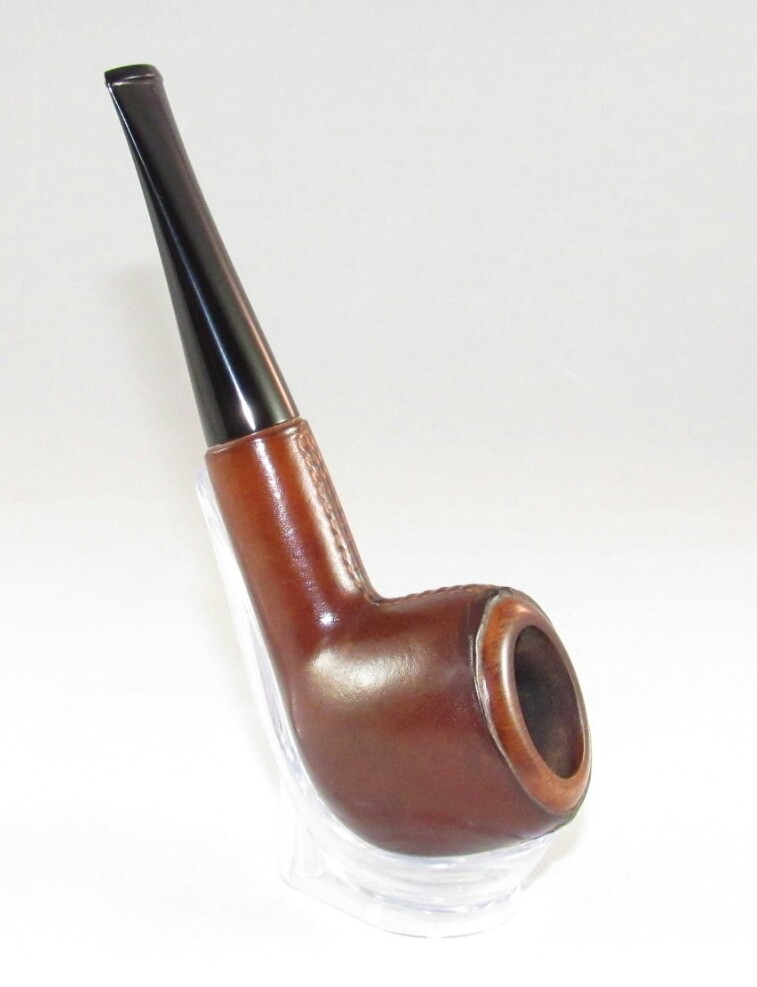
My Daughters Pick, A Leather Covered LONGCHAMP OVAL BOWL

Screenshot_2016-02-01-16-15-06~2
Photo and Information Courtesy of Pipedia.
In 1948 Jean Cassegrain inherited a small shop near the French Theater on the Boulevard Poissonnière in Paris, called “Au Sultan”. Articles for smokers and fountain pens were offered there.
Now, the absolute bulk of the pipes Cassegrain found in the inventory was from war-time production and due to the sharp restrictions on pipe production the French government had enforced in 1940, these pipes were of very poor quality and showed large fills. Strictly speaking, they were not marketable now that the French pipe industry produced pipes of pre-war standards again. In this situation Cassegrain had the probably most enlightened moment in his life: he took some of these pipes to a leather worker who clad bowls and shanks in leather. Only the rims of the bowls and the shanks’ faces remained blank.
I like to get more bang for my buck, so I like to go after pipes listed in lots, keeping what I want and donating or selling off what doesn’t catch my eye. As the small flat rate box fills with extra pipes, I’ll take the box to my wife and daughter to see if anything catches their fancy. Usually it’s let em go to someone else but for some reason the leather-covered LONGCHAMP pipes my daughter found unique. She’s ten now and has taken an interest in some of my refurbishing projects. I have a few in my rotation that she wouldn’t let go, a red Color Duke by Dr.Grabow, a cheerywood Ropp and a BamBoo Briar.


Back Out Of The Box


20160201_134221~2~2PhotoGrid_1454378320469PhotoGrid_1454378094735

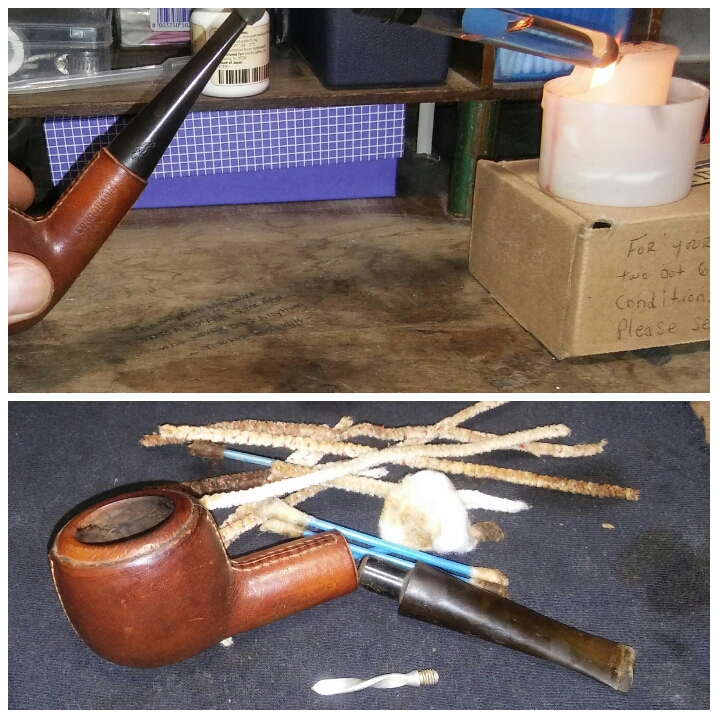
The pipe was in good shape, leather wrap was a little dry & dirty, worn button, deep tooth impressions, oxidation, rim darkening and brittle cake.

20160201_134651~2

A conventional reamer would not work with a ovel bowl, instead I started with 220 grit sandpaper and finished with 400 grit sandpaper.

PhotoGrid_1454378176042

The internals were caked in old tars,oils and tobacco. I ran it though a retort using EverClear and cotton balls. I then did a thorough cleaning of the chamber, mortise and stem with EverClear, Q-tips and stiff /soft pipe cleaners. Cleaning until the last pipe cleaner came out as it went in.

PhotoGrid_1454378586208

There were a few dings in the rim, using a household iron on medium/ high heat and a damp rag I would steam out the imperfections. Covering the rim with the damp rag and applying it to the hot iron working in intervals until the imperfections were almost gone.


20160201_144035~2

What was left of the imperfections and darkening, I removed with worn micro-mesh pads.


PhotoGrid_1454378274729

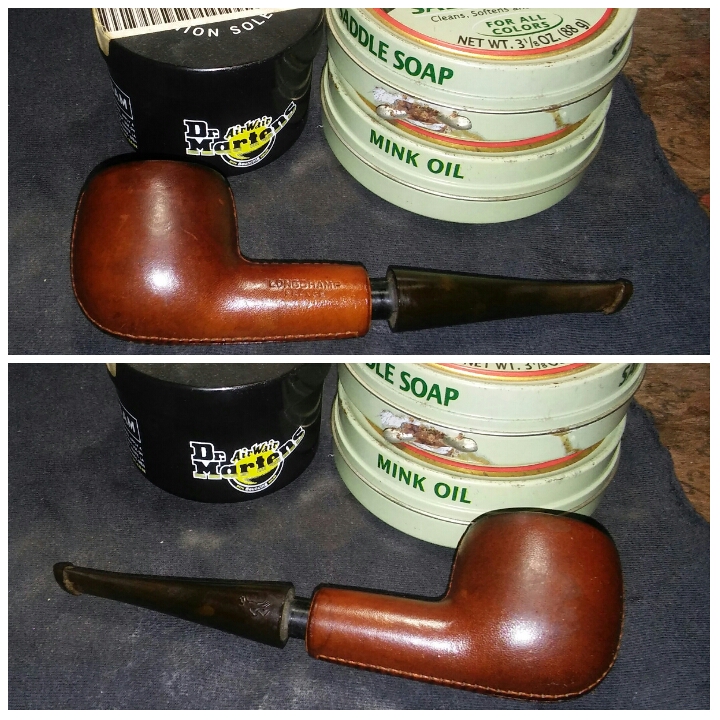
The leather covering was dry and grimy. I busted out my wife’s leather cleaning products. I started with saddle soap to clean away the grease and grime, being careful not to get it into the chamber or mortise. I then switched to Doc Martin’s leather conditioner and finally ended with mink oil. The leather was now soft and supple.

PhotoGrid_1454378217030PhotoGrid_1454378455047

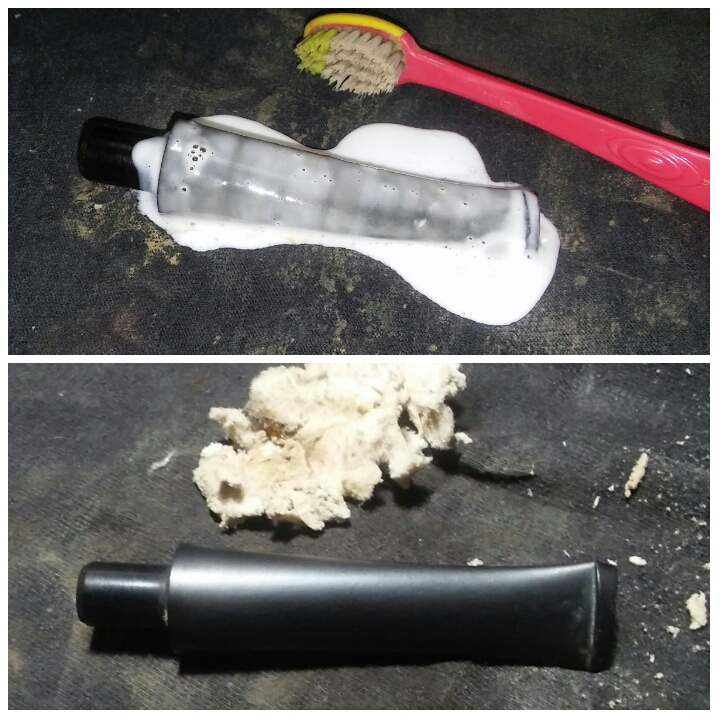
The oxidized stem, I applied a generous amount of non-bleach Soft Scrub to the stem with a children’s toothbrush and left it aside to penetrate the oxidation. Once the Soft Scrub turns from white to a brownish color its time to scrub vigorously with a rag until the oxidation is removed, finishing up with a damp Magic Eraser to remove the leftover oxidation.

PhotoGrid_1454378192141

It was now time to address the tooth impressions, I first roughed up the area of repair with 400 grit sandpaper so my fill would have a good hold and then cleaning with EverClear to remove my sanding dust.

20160201_205051~2

To fill the deep impressions and rebuild the worn button I mixed thick black CA glue and activated charcoal power into a paste and applied it to the impressions/button using a toothpick. I then hit it with accelerator to set the repair, leaving it aside to cure overnight.

PhotoGrid_1454391163072

Now that the repair had time to cure overnight, I could shape the new button. Using a flat needle file I removed the excess until I had an uniformed shape.

PhotoGrid_1454391187726

Once the new button was at a suitable thickness I moved to 400 grit sandpaper to remove the file marks.

20160202_122051~2

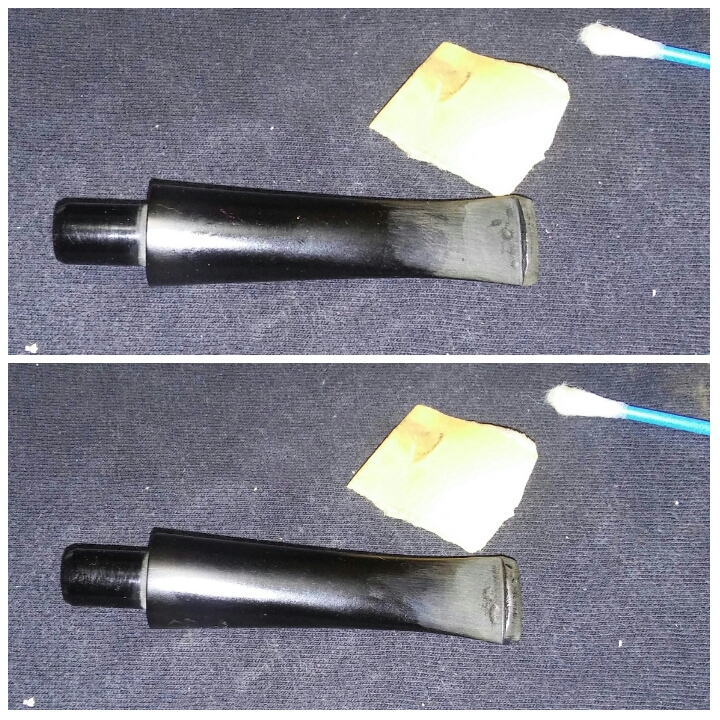
Before hitting the micro-mesh, I re-touched the logo. I tried multiple applications Rub & Buff, White Out Pen and finally white nail polish, which was the winner.

20160207_031839~2

I then sanded the whole stem with 1000 grit sandpaper wet, then ran it though the various grits of micro-mesh pads, 1500-2400 wet and 3200-12000 dry. Stummel and stem complete she was now ready for the final buffing.

Complete.

PhotoGrid_145493989014620160208103921~220160208103950~220160208104018~2

Finished up the rim on the wheel with white diamond, a few coats of carnauba and a microfiber hand buffing. I lightly buffed the leather covering with a clean buffing wheel. Buffing the stem with blue compound.

Thanks For Taking A Look.


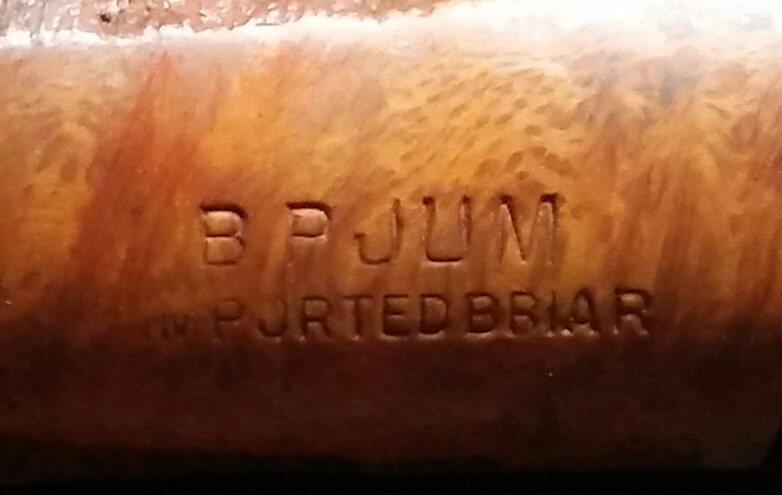
B P JUM

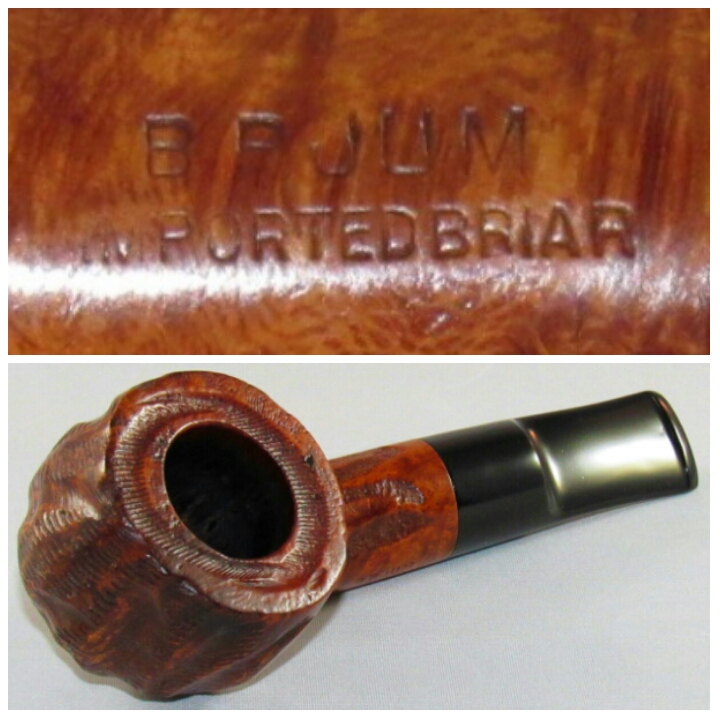
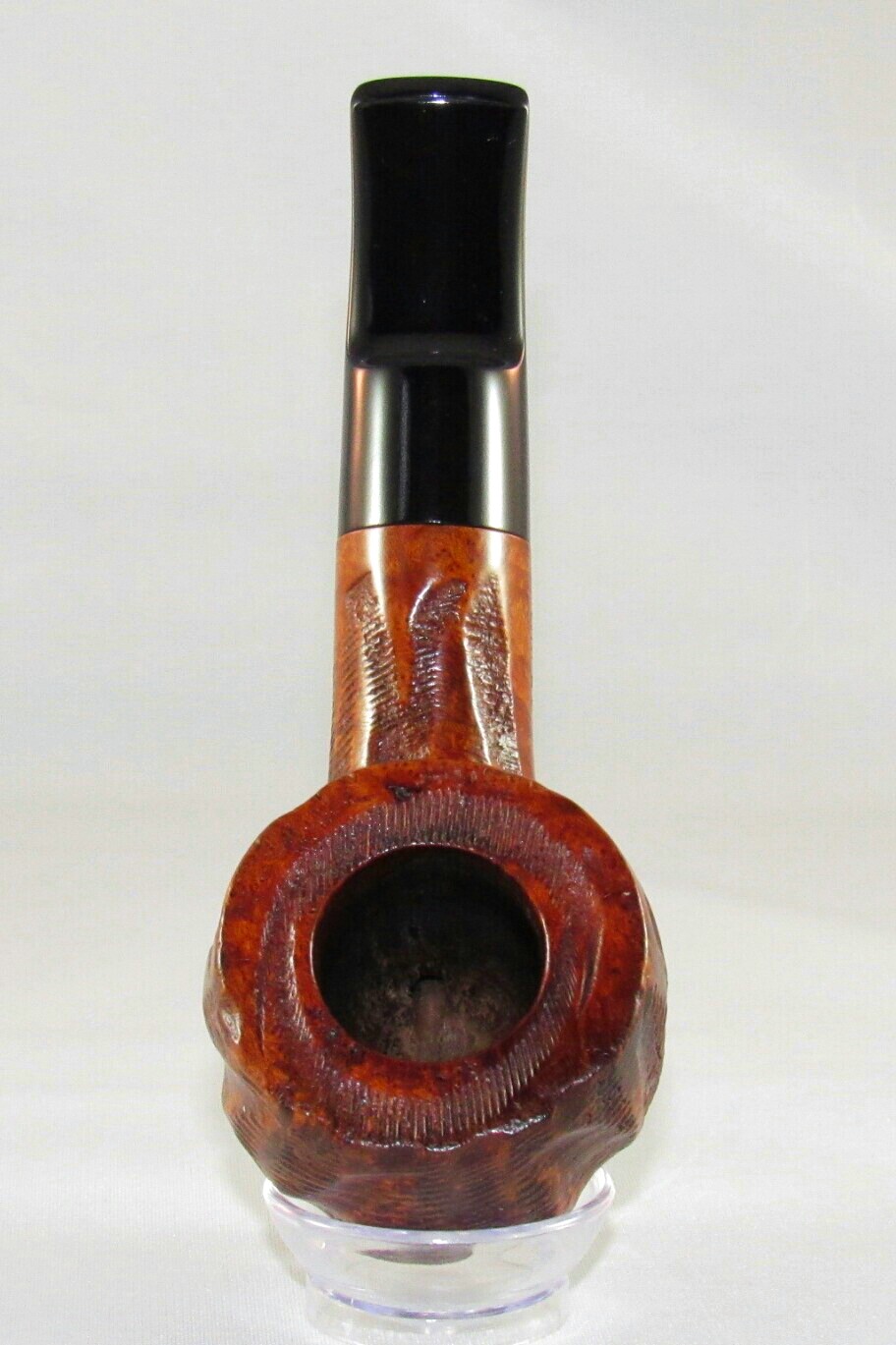
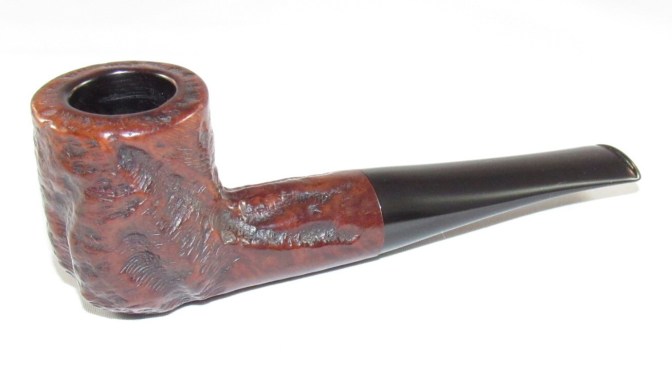
B P JUM Imported Briar.

I have a few in my collection some of my favorites, they smoke cool and comfortable in the hand. I have yet to find any information or advertisement for these pipes. Bill Unger suspected they could have been produced by Mincer but there was no evidence.


As Received.

20160130_141655~2PhotoGrid_1454187976270PhotoGrid_1454188001227PhotoGrid_1454188024564

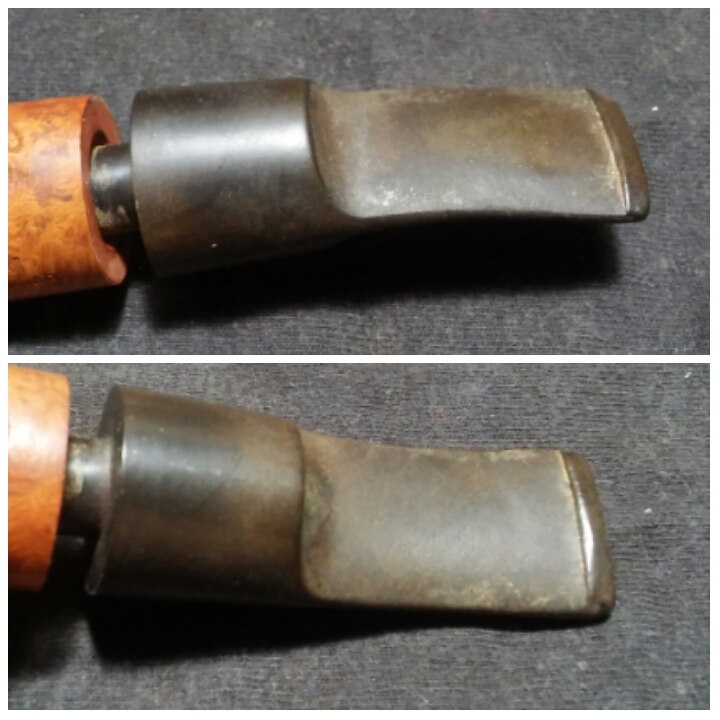
Over all she was in good shape. The stem was oxidized with a little chatter, a bridle cake, rim tar and char. There was also embedded metal in the stem which gave the stem a rough oxidized surface. The embedded metal is something I’ve run into before and tells me the pipe was produced during war-time late 40’s -50’s, they were using recycled rubber to manufacture the hard rubber stems.

PhotoGrid_1454199523168

First I started with my Pipnet Reamer and the smallest attachment working up to the largest that the chamber would except in this case it would accept the largest. I smoothed things out with 400 grit sandpaper wrapped around a finger.

PhotoGrid_1454188104573

After completing the chamber my attention turned to the internals of the mortise and stem, they were pretty caked with tar, oils and old tobacco. I decided a retort was in order. Using EverClear and cotton balls I ran the pipe though the process. After the retort loosened the internal debris I did a cleaning using EverClear, Q-tips, un-rolled cotton balls and stiff/soft pipe cleaners. I cleaned the internals until the pipe cleaners came out as they went in.

20160130_154652PhotoGrid_1454199196034

Now for the caked rim. I applied a generous amount of Method Good For Wood Polish to the rim and set it aside to allow the polish to soften the build-up. After sitting, I removed the build-up with Q-tips and a rag working until the rim free of debris. I did repeat this process a few times.

PhotoGrid_1454199223426

With the stummel ready for the wheel, I could now concentrate on the stem oxidation. I applied non-bleach Soft Scrub to the stem with a children’s toothbrush and left it aside to penetrate the oxidation. Once the Soft Scrub turns from white to a brownish color its time to introduce the old elbow grease and scrub vigorously with a rag until the oxidation is removed, finishing up with a damp Magic Eraser to remove the leftover oxidation.

20160131_005920~2

I now ran the stem through the various grits of sandpaper and micro-mesh. I removed the chatter with 1000 grit sandpaper wet and then moved on to the first three micro-mesh pads 1500 mesh wet, 1800 mesh wet, 2000 grit sandpaper wet and 2400 mesh wet. I ran it though the last six micro-mesh pads dry 3200-12000. The metal flecks are still are still visible, I have many in my collection from the same war-time era where the flecks are apparent.

20160131_011026~2

Just before hitting the wheel I applied Howard’s Butcher Block Conditioner with a rag and let it penetrate for a few minutes, hand buffing off the excess with a clean rag. She was now ready for the final buffing.

Complete.

PhotoGrid_1454271693417PhotoGrid_145427104234920160131164943~220160131165011~220160131165021~2~2

Finished up on the wheel with white diamond, a few coats of carnauba and a microfiber hand buffing. Buffing the stem with blue compound.
Thanks For Taking A Look.


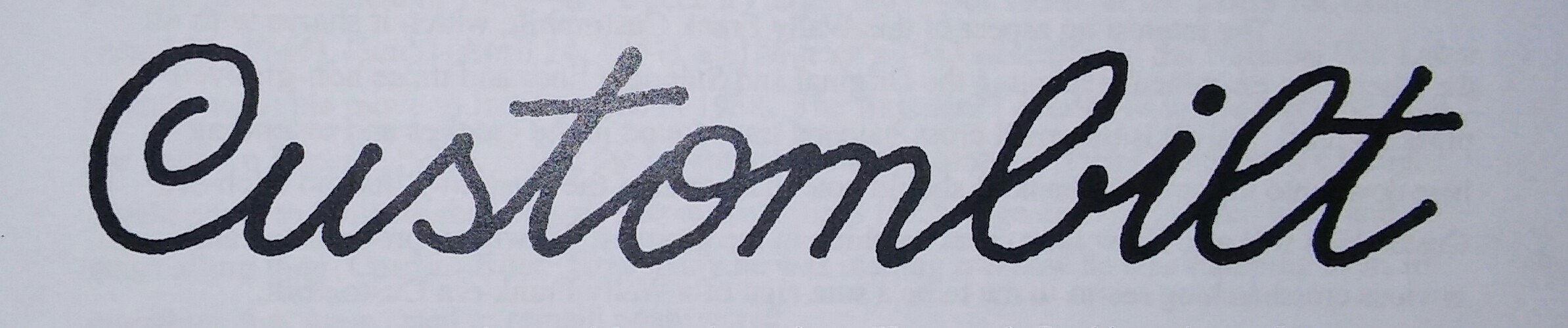
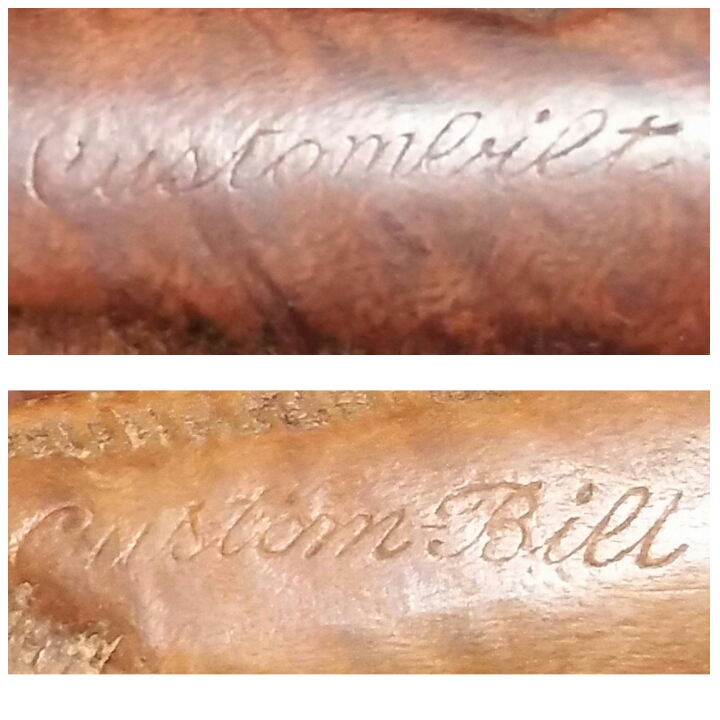
Custombilt ( Rare Stamping )

20160129_100652~220160129_103155~2

This stamping was a puzzler for Bill Unger, as he wrote in his book. It’s equally as puzzling for me, out of the thirty or so in my collection this is the only one with this stamping. Bill found that the stamping was used on what he thought was a Eugene Rich Era and Wally Frank Era Custombilt pipe. My example I could swear is Tracy Mincer Era.
PhotoGrid_1454081640667 PhotoGrid_1454081722255   
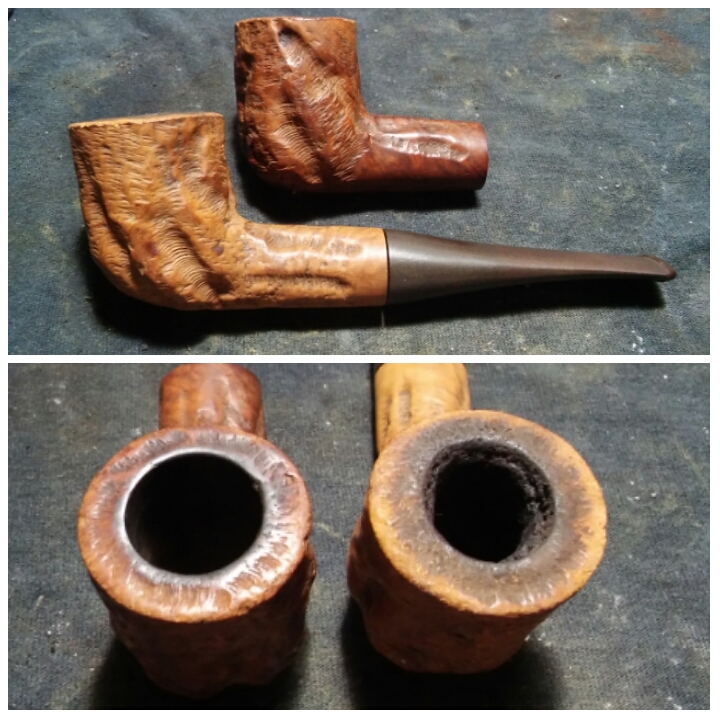
  I received two pipes from the same seller one marked with the standard Mincer stamp and shape stamp  of a triangle, the other pipe has the rare stamp and a shape stamp of a square. Both pipes are of similar medium size and deep rustication. I have seen sets with two pipes in a claim shell case and I think that’s what I have here, minus the case. Any Custombilt collectors with more information please leave a comment.
Pipe As Received.

PhotoGrid_145407098617420160128_193743220160128_1937542PhotoGrid_1454071030116PhotoGrid_1454071008778

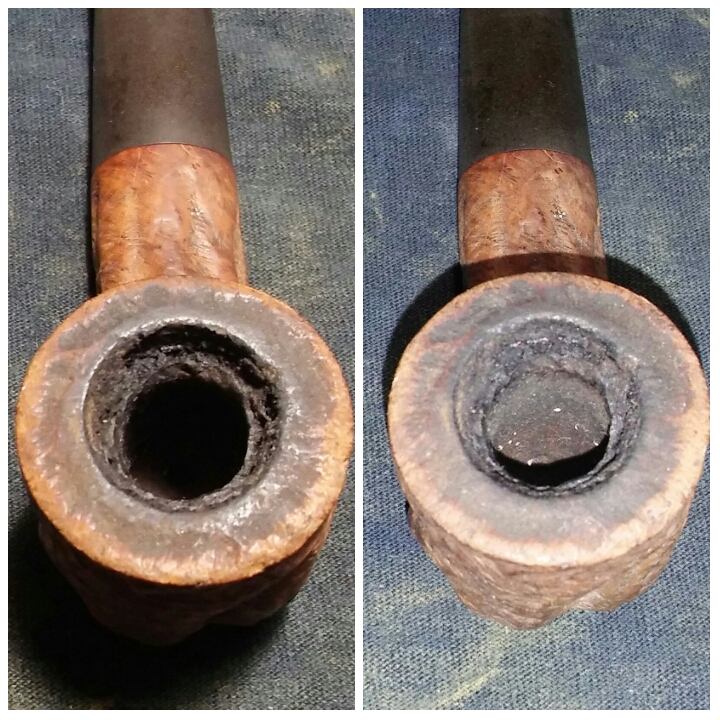
Very well-loved, thick cake, oxidation, worn button, rim char, rim tar and worn finish.

20160128_231701~2

I started with my Pipnet Reamer and the smallest attachment working up to the second largest. Finished with 400 grit sandpaper wrapped around a finger.

PhotoGrid_1454104869641

The rim was embedded with tars ,oils and char. I applied a generous amount of Method Good For Wood Polish to the rim and set aside to penetrate the build-up. I removed the build-up with Q-tips. I removed the rim char and darkening with worn micro-mesh until it faded.

PhotoGrid_1454104405876

The pipe was heavily smoked, I decided to run a retort using EverClear and cotton balls. I would repeat the process twice to get a good clean.

20160129_114700~2

After the retort I cleaned the internals of the stummel and stem with EverClear, Q-tips, stiff/soft pipe cleaners, a mortise brush and a shank brush. Cleaning until the last pipe cleaner came out clean.

PhotoGrid_1454104731247

I now turned to the oxidized stem, I applied non-bleach Soft Scrub to the stem with a children’s toothbrush and left it to penetrate the oxidation. Once the Soft Scrub turns from white to a brownish color, I scrubbed vigorously with a rag until the oxidation was removed, finishing up with a damp Magic Eraser to remove the leftover oxidation.

20160129_131822~2

The button was worn down and would have to be built back up. I first taped off the button portion of the stem with blue painters tape so my work would remain in one area. I mixed thick black CA glue and activated charcoal power into a paste .

PhotoGrid_1454104278156

 I applied the paste to the button with a toothpick, then removing the tape just before hitting with the accelerator. I left it aside for a few hours to cure.

PhotoGrid_1454104355842

Once the repair had time to cure, I could begin to form the new button. Using needle files I shaped the button to a suitable thickness. I finished up with 400 grit sandpaper wet to remove the file marks.

20160129_163406~2

I now ran the stem through the various grits of sandpaper and micro-mesh. 1000 grit sandpaper wet, 1500 mesh wet, 1800 mesh wet, 2000 grit sandpaper wet and 2400 mesh wet. Then finishing up with the rest of the micro-mesh pads 3200-12000 dry.

PhotoGrid_1454104577491

Just before hitting the wheel I applied Howard’s butcher block conditioner to the stummel with a rag and let it penetrate for a few minutes hand buffing off the excess with a clean rag. The change in coloring of this pipe was incredible after applying the Howard’s Conditioner. I use Howard’s butcher block conditioner on all my Custombilt, Tom Howard, BP Jum and Kaywoodie Handmade pipes before buffing.

Complete

PhotoGrid_1454124028848PhotoGrid_145412399569820160129235625~220160129235652~220160129235744~2

 I finished her up on the wheel with white diamond, a few coats of carnauba and a microfiber hand buffing. Buffing the stem with blue compound.

Thanks For Taking A Look.

Custom-Bilt (Mincer Era)

20151009_1027472_zpsuvvs9drj~2

. Mincer Era Custom-Bilt .

Screenshot_2015-12-07-07-27-00~2

I love when auctions go this way , I only wish I was the one who won it. My wife took a chance on this one and gave it to me for Christmas. Sure enough its a Custom-Bilt, the nomenclature is worn or lightly stamped but its there. I have so many in my collection and I talk about them constantly she knows exactly what to look for.

As Received

PhotoGrid_1453699522594PhotoGrid_145369957971420160124_210347~220160124_210431~2

She was in rough shape when received, thick crumbling cake, stem oxidation and the tennon was glued into the mortise. Once the the glue was removed from the tennon and mortise, I realized the glue was the previous owners attempt to fix a loose fitting stem. In my excitement Christmas morning I had already removed the glue. Using EverClear I filled the chamber and left it to soak, eventually I was able to free the stem from the stummel.

PhotoGrid_1453699681920

I set the stem aside to come back to and started with the stummel. I started with my Pipnet Reamer and the smallest attachment and worked up to the third attachment, finishing up with 400 grit sandpaper wrapped around a finger. The chamber was well preserved from the thick cake, no cracking or pitting.

PhotoGrid_1453761268436

Next the rim tar and char, I applied a generous amount of Method Good For Wood Polish with a Q-tip and allowed it to penetrate the residue. I had to repeat the process a few times to remove all the build up, using Q-tips.

PhotoGrid_1453760194830

After freeing the tennon from the mortise Christmas morning there was still glue leftover one the stem, mortise and tennon. I used EverClear Q-tips and makeup pads to remove the rest of the glue.


20160124_231118~220160124_231247~2

I did a quick internal cleaning to remove the loose debris using EverClear, Q-tips and stiff/ soft pipe cleaners. I then did an alcohol and cotton ball soak on the chamber allowing it to absorb the oils and tars, leaving it overnight.

PhotoGrid_1453749192862

The following morning I decided to run a retort using EverClear and cotton balls. I then cleaned the internals of the stummel and stem with EverClear,Q-tips,cotton balls and stiff /soft pipe cleaners, cleaning until the pipe cleaners came out as they went in.

20160125_091354~2

The stummel was pretty caked with dirt and oils. I wiped down the stummel with EverClear and makeup pads making sure I got into the crags.

PhotoGrid_1453749307223

Next the rim dings, using a household iron on medium /high heat and damp rag. I  covered the rim with the damp rag and applied the rim to the hot iron working in intervals until the imperfections were almost gone.

PhotoGrid_1453749336366

Happy with the rim, I now applied Howard’s butcher block conditioner to the stummel using rag and Q-tip to get into the deeper crags and left it aside for a few minutes to penetrat. Hand buffing off the excess.

PhotoGrid_1453749071378PhotoGrid_1453749128658

The stem was heavily oxidized, I applied non-bleach Soft Scrub to the stem with a children’s toothbrush and left it aside to penetrat the oxidation. Once the Soft Scrub turns from white to a brownish color its time to scrub vigorously with a rag until the oxidation is removed. I would repeat this process a few times and finish with a damp Magic Eraser to remove the leftover oxidation.

PhotoGrid_1453749144980

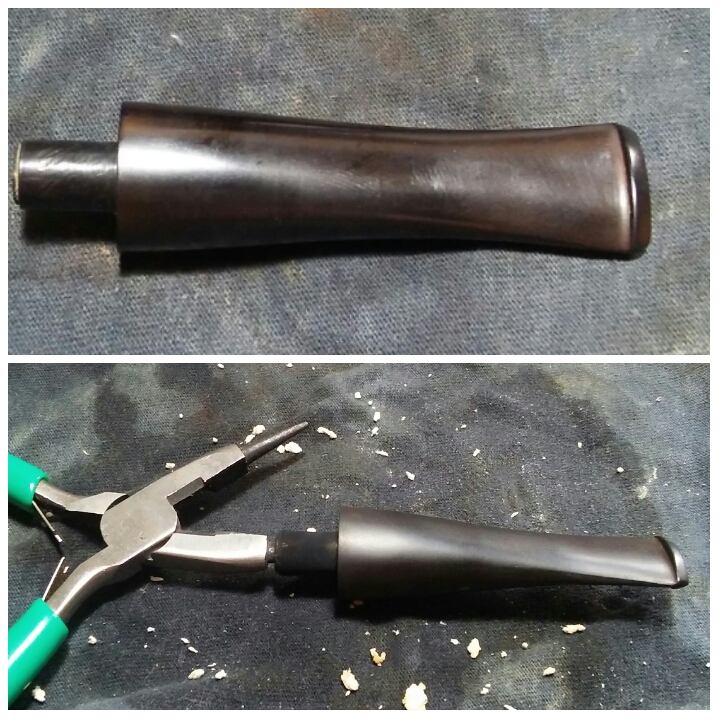
The loose fitting tennon, I heated the tennon with a Bic Lighter (moving the flame at all times never leaving it in one spot too long) and inserted the tip of round tipped jewelry pliers into the tennon and slowly expanded the tennon from the inside out until a snug fit between mortise and tennon was achieved.

20160125_112623~220160125_165534~2

I now ran the stem through the various grits of sandpaper and micro-mesh. I tapped off the shank with blue painters tape so my sanding would remain on the stem. I removed what little chatter there was with 1000 grit sandpaper wet and then moved on to the miro-mesh pads 1500-2400 wet and 3200-12000 dry. She was now ready for the wheel.

Complete

20160125224057~220160125224119~220160125224135~2PhotoGrid_1453773455838PhotoGrid_145377340917320160125224406~2

Finished her up on the wheel with white diamond, a few coats of carnauba and a microfiber hand buffing. Buffing the stem with blue compound.

Thanks For Taking A Look.